This glossary defines the terms that come up when Calgary homeowners, buyers, sellers and landlords deal with a sewer line: pipe materials and City data codes, repair methods, quote and payment language, insurance coverages and the real estate terms used when a sewer problem affects a purchase or sale. Real estate and legal terms are general descriptions, not advice.
- City data terms such as TIL, TP and OTHER are the City's codes; only some are defined in its metadata.
- Money terms such as planning range, unit rate and holdback decide how a sewer job is priced and paid.
- Purchase terms such as condition, going firm and price adjustment are for discussion with your REALTOR® and lawyer.
01 /How to use this glossary
Entries run from A to Z. Every definition is written for Calgary: where a term involves the City of Calgary, the definition says what the City has published and where to confirm it. Where a term is a real estate or legal concept, the definition is general information only; your REALTOR® and lawyer apply it to your situation.
For costs behind the money terms, see sewer line replacement cost in Calgary and the Calgary Replacement Cost Estimator. For the buyer terms in action, start with the Home Buyer Sewer Risk Check. Questions answered in a sentence or two are in the FAQ.
A–ZTerms
- 311
- The City of Calgary's service line for non-emergency requests. It is the first call for possible City-side sewer problems, backups affecting the street, record corrections and questions about permits or work near City property.
- Access pit
- A small excavation dug to reach a pipe for trenchless work or a connection. Bursting needs one at each end; lining can often work from a cleanout instead.
- After-video
- A camera recording of the line after repair or replacement. It is the best proof of what was done and belongs in the house records and any sale file.
- As-improved value
- The estimated value of a home once planned improvements are finished. Some improvement mortgages, such as CMHC Improvement, use it to set how much can be borrowed.
- Backfill
- Material placed back into a trench over and around new pipe, compacted in layers. Poor compaction leads to settlement in lawns and driveways.
- Backwater valve
- A valve on the building drain that closes when sewage flows back from the City side, protecting below-grade fixtures. The City of Calgary recommends one on below-grade fixtures.
- Bedding
- Granular material under and around a pipe that supports it on grade. Poor bedding is a common cause of sags in older laterals.
- Bell-and-spigot joint
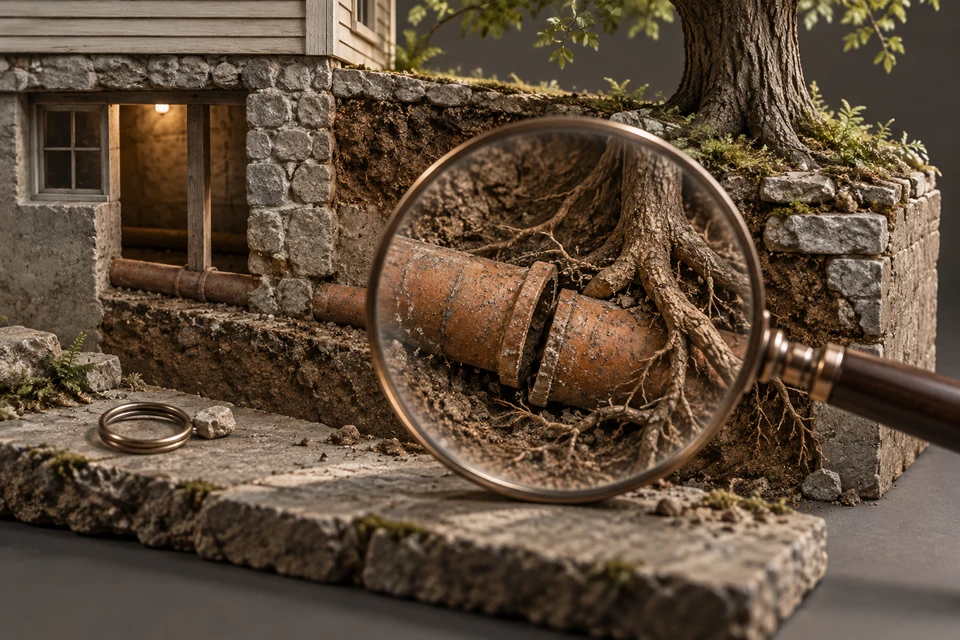
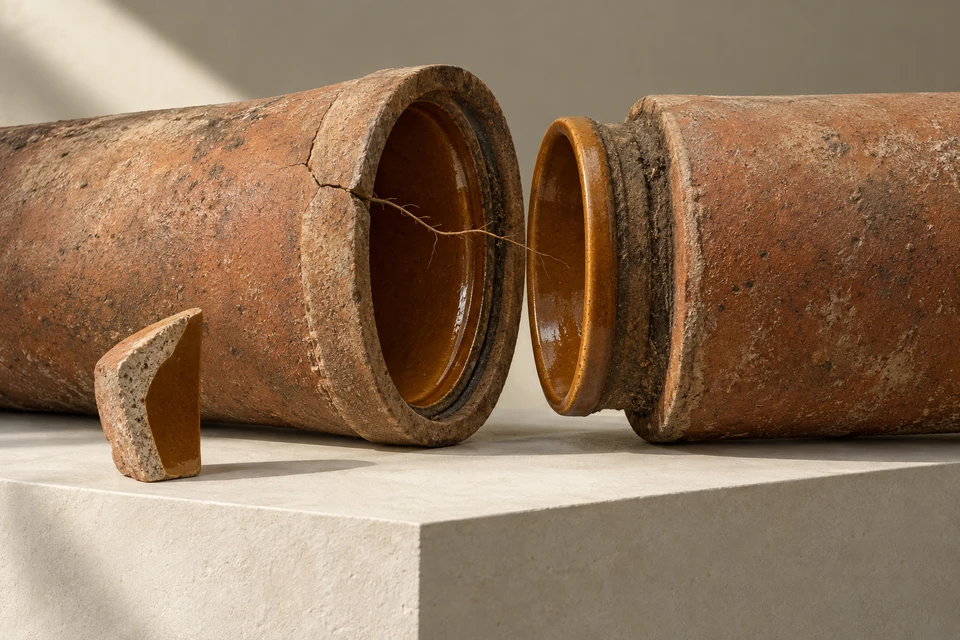
- A joint where the plain end of one pipe section slides into the flared bell of the next. Clay and some cast iron laterals are built this way, and the joints are where roots enter.
- Belly (sag)
- A dip in the pipe's grade where wastewater pools and solids settle. A liner copies the dip instead of correcting it, so a belly usually needs excavation and re-laying.
- Building drain
- The section of sewer pipe under the basement floor, from the plumbing stack to the foundation wall. Many replacement quotes stop outside the foundation, so ask whether it is included.
- Building sewer
- The pipe that carries wastewater from outside the foundation to the City connection; in everyday use, the lateral or service line.
- Cast iron (CI)
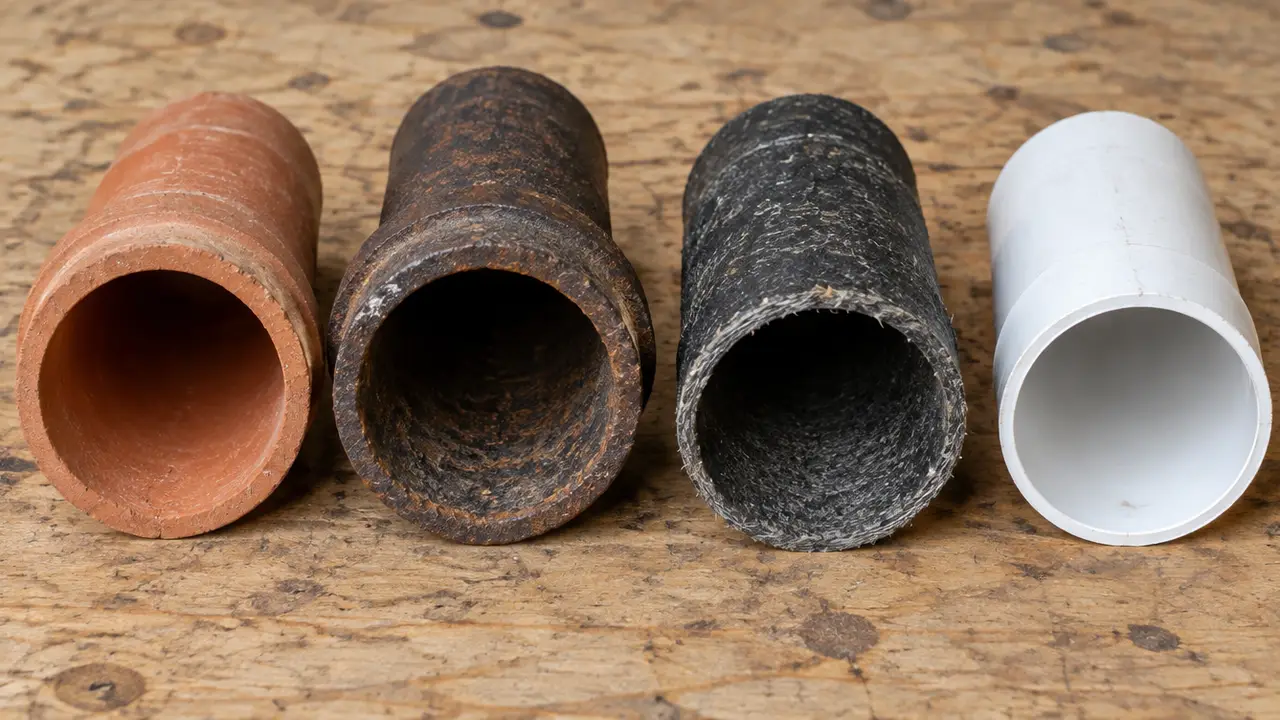
- Heavy metal drain and sewer pipe that corrodes from the inside into rough scale. The City's CI code covers 3.3% of Calgary's City-side service lines, concentrated in 1950s to 1970s installs.
- CIPP (cured-in-place pipe)
- A lining method that cures a resin-saturated liner inside an old pipe, forming a new jointless pipe. In the City's records, a CIPP date is usually the relining date.
- City-owned portion
- The part of a service line from the sanitary main to the property line. The City of Calgary's dataset description says it is owned and maintained by the City.
- City-side connection work
- Work at or past the property line, such as a boulevard or road excavation, needed for some repairs and most new services. The Calgary estimator adds $3,000 to $15,000 for it.
- Cleanout
- The capped opening crews use to get cables and cameras into the line. The main one is usually in the basement floor near where the water service enters, and should never be buried under flooring.
- Condition
- A term in a purchase contract that must be satisfied or waived by a deadline, such as financing or inspection. A sewer scope is usually arranged under an inspection condition.
- Customer Service Report (CSR)
- The report a City of Calgary Water Services crew leaves after attending a sewage backup call, recording what it found and next steps.
- Deductible
- The amount an insured person pays toward a covered claim before the insurer pays. Sewer backup and service line coverages often have their own deductibles and limits.
- Descaling
- Cutting corrosion scale out of cast iron pipe with specialized heads, usually before lining. It restores the bore but does not restore thinned pipe walls.
- Easement
- A registered right for someone else to use part of a property, such as for a utility line. Easements and rights-of-way appear on title and limit what can be built over them.
- Firm (going firm)
- The point in a purchase when all conditions are satisfied or waived and the contract becomes binding without them. Sewer due diligence should be finished before this.
- GST
- The federal Goods and Services Tax. Alberta has 5% GST and no provincial sales tax, so compare Calgary sewer quotes before tax and add GST once.
- HDPE
- High-density polyethylene, a tough flexible plastic pipe commonly pulled in behind a bursting head. It appears in only a handful of Calgary's City-side records.
- Holdback
- Money kept back from sale proceeds or a contract payment and held, often in a lawyer's trust account, until an agreed condition such as a completed sewer repair is met.
- Home warranty plan
- A third-party service contract for home systems. It is neither insurance nor the statutory new home warranty, and many plans limit or exclude buried sewer lines.
- Homeowner permit
- A City of Calgary plumbing permit for an owner who lives in, or intends to live in, the home and is doing the work personally. It is not available for rental properties.
- Infill
- A new house built on a lot in an established community, usually after demolition. Infills often need a replaced or new sewer service, set by City requirements.
- Lateral
- The sewer service line from a house to the City main. In Calgary it has a private portion and a City-owned portion, divided at the property line.
- Locate (public)
- Marking of buried utilities registered with Utility Safety Partners, Alberta's one-call service, before digging. Requests should be placed at least three full working days ahead.
- Master Indemnification Agreement
- A City of Calgary requirement that contractors installing water and sewer connections must meet, according to the City's guidance on installing connections.
- Material latent defect
- In RECA's consumer information, a hidden physical issue that, among other things, would be very costly to repair or makes a home unsafe. Whether a sewer problem qualifies is a legal question.
- New home warranty
- Alberta's mandatory warranty for new homes permitted after 1 February 2014: at least one year for labour and materials, two years for delivery and distribution systems including plumbing, five for the envelope and ten for major structure.
- Offset joint
- Two neighbouring sections that no longer line up, leaving a lip inside the pipe. Small ones are often just watched; large ones snag paper and give roots a way in.
- Open cut
- Trenching along the line and laying new pipe in it. It handles every defect, sags and collapses included, and is most expensive where concrete or finished space sits on top.
- OTHER code
- A material code in the City's service line data that the City does not define. Most pre-1950 records carry it, so it signals an old line of unknown material.
- PACP
- NASSCO's Pipeline Assessment Certification Program, a standard system for coding and grading pipe defects on camera. Useful, though not required, for a house purchase.
- Pipe bursting
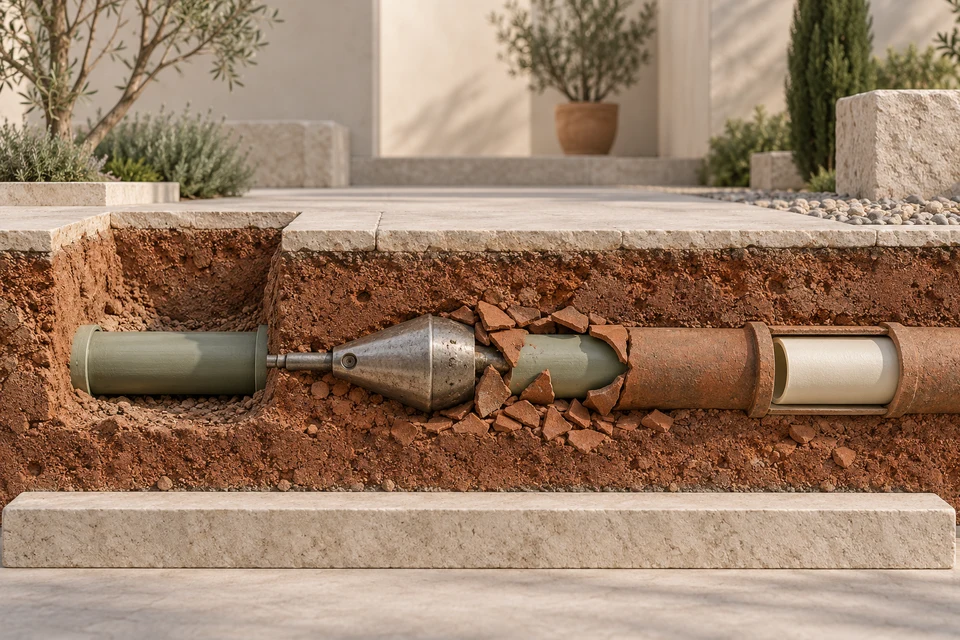
- Replacing a pipe by pulling a bursting head through it, fracturing the old pipe outward while new pipe follows. It needs pits at each end and follows the old route.
- Planning range
- A low-to-high estimate used to budget and test quotes before a contractor has seen the line. It is not a price or an offer.
- Price adjustment
- A reduction in a purchase price agreed after a defect is found. It gives the buyer control of the repair but not the cash to pay for it.
- Private locate
- Locating customer-owned lines, such as your own sewer lateral, which public locate services do not mark. Usually done with a camera and a sonde.
- Private portion
- The part of the service line from the property line to the house. The City of Calgary's dataset description says it is owned and maintained by the homeowner.
- Property line
- The legal boundary of a lot. In Calgary it marks where responsibility for a sanitary service line passes from the homeowner to the City.
- PVC
- Polyvinyl chloride plastic pipe, the dominant sewer material in Calgary since the 1980s and 66.5% of City-side service line records.
- Real Property Report (RPR)
- A legal survey document commonly used in Alberta sales that shows buildings and improvements relative to property lines. Useful for estimating where the property line falls on a scope.
- REALTOR®
- A trademark identifying real estate professionals who are members of the Canadian Real Estate Association. Your REALTOR® negotiates sewer issues in a purchase or sale.
- Reinstatement
- Reopening a branch connection from inside a newly lined pipe so that it drains again. A connection left partly blocked is a common finding on a lining job.
- Relining
- Installing a new liner inside an existing pipe, most often by CIPP. About 1.1% of Calgary's City-side lines are recorded as relined.
- Repair before closing
- An agreement that the seller will have a defect fixed before possession. Its value depends on how precisely the method, extent and proof of completion are written.
- Restoration
- Rebuilding what was disturbed by the work: lawn, landscaping, concrete or a basement floor. Often the line item that separates a mid-range quote from a high one.
- Sanitary main
- The public sewer pipe under the street or lane that collects wastewater from every service along it. It is City infrastructure.
- Service line coverage
- An optional insurance endorsement, offered by some insurers, that can pay to repair buried private service lines after a covered failure. Age and wear are commonly excluded.
- Sewer backup coverage
- Optional home insurance coverage for damage inside the home when sewers or drains back up. It does not normally pay to replace the pipe.
- Sewer reserve
- Money a buyer or owner sets aside for future sewer work, sized from the scope result and the pipe material rather than the asking price.
- Sewer scope
- A recorded camera inspection of the drain line from the house toward the City connection, with distances and located defects. In Calgary it typically costs $250 to $600.
- Sonde
- A small radio transmitter in a camera head that lets a locator on the surface find the camera's position and depth.
- Spot repair
- Fixing one defect by a single dig or a short sectional liner. In the Calgary estimator it is a flat $4,500 to $12,000 before depth and surface adjustments.
- Structure class
- The City of Calgary's grouping of communities by development era or type, such as 1950s, 1960s/1970s, Inner City or Building Out.
- TIL code
- The City's material code for about one in five Calgary service lines. The metadata gives no definition; the accepted reading is clay tile.
- TP code
- Another unexplained material code in the City's service line data. Nearly every record carrying it is dated in the 1950s or 1960s.
- Trench protection
- Sloping, benching, shoring or a trench box that keeps trench walls from collapsing. Generally required under Alberta occupational health and safety rules for trenches deeper than about 1.5 m.
- Unit rate
- A price per unit of possible extra work, such as per extra metre or per hour of rock breaking, written into a quote so surprises have a known cost.
- Vitrified clay pipe (VCP)
- Clay pipe fired until it partly fuses into a dense ceramic. Durable and corrosion-resistant, but brittle and jointed every short section.
- Wall crossing
- The point where the sewer passes through or under the foundation wall. Pipe material often changes here, and quotes should state which side of it the work covers.
- WCB clearance letter
- Proof from the Workers' Compensation Board that a contractor is registered and up to date, which owners commonly ask for before a crew starts.
- Winter factor
- The Calgary estimator's multiplier of 1.10 to 1.25 for winter work, reflecting frost removal, slower digging and restoration that is often temporary until spring.