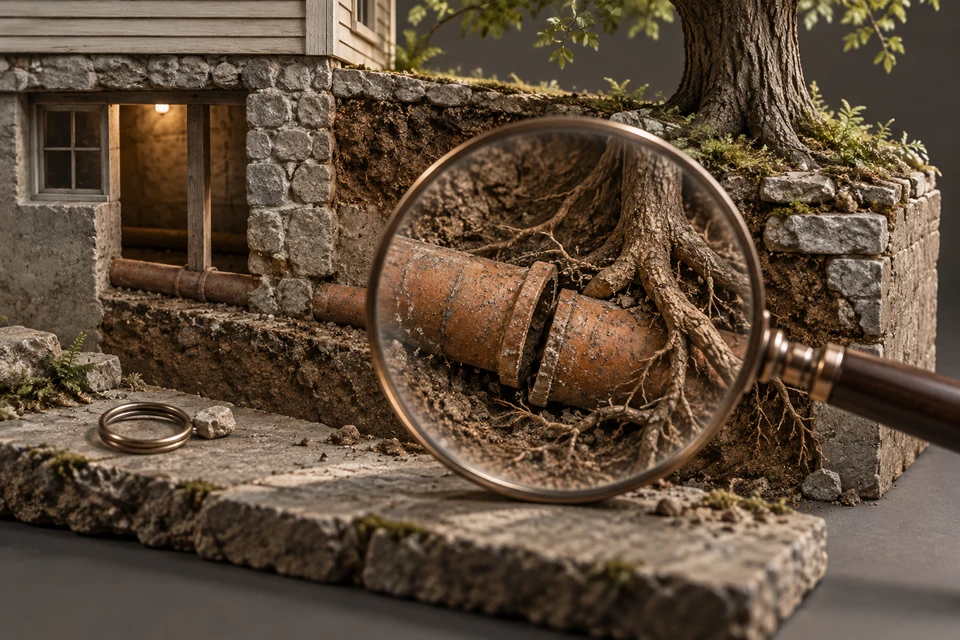
The Home Buyer Sewer Risk Check scores a Calgary home's sewer line from six facts: pipe material, the year built or installed, big trees near the line, a finished basement, what the seller disclosed and whether a sewer scope has been done. It returns a Low, Moderate, High or Very high band, the reasons behind it and a checklist for your condition period.
- The score is a simple points total, shown with its reasons, so you can see exactly why a house landed in its band.
- Clay, cast iron and unknown materials add the most points; a clean sewer scope takes two away and a scope with defects adds three.
- Every result includes the same first step: get a sewer scope before the purchase goes firm.
- High and Very high results add a written replacement quote and a conversation with your REALTOR® and lawyer about price adjustment, repair before closing or a holdback.
- The optional address lookup reads the City's record for the City-owned portion only; the private side can differ.
Home Buyer Sewer Risk Check
01 /What does the Home Buyer Sewer Risk Check do?
The Home Buyer Sewer Risk Check turns what a buyer can learn in the first days of a Calgary purchase into a sewer risk band and a to-do list. It does not diagnose the pipe. It tells you how much weight to give the sewer line in your due diligence, and what to have in hand before you remove conditions.
It is built for resale houses in Calgary, especially the 1950s to 1970s communities where the City's own records show clay tile and cast iron service lines are common. It works for any house, including new ones, where it will usually return Low and still tell you to scope.
02 /What do I enter?
There are seven inputs. Only the first is optional.
| Input | Choices | Where to find it |
|---|---|---|
| Address lookup (optional) | House number and street | Queries the City of Calgary's public service line data live and pre-fills material and year |
| Material | TIL/clay, CI (cast iron), PVC, CIPP (relined), TP / OTHER / unknown | The lookup, a previous scope report, or the seller |
| Year built or installed | A year | The listing, the lookup, or permit records |
| Big trees near the line | Yes or no | Look between the house and the street or lane, including boulevard trees |
| Finished basement | Yes or no | The listing or your showing |
| Seller disclosed backups or repairs | None, yes, or unknown | Ask through your REALTOR® |
| Scope done | No, yes and clean, or yes with defects found | Your own scope, or a recent one the seller provides |
If you know the private-side material from a scope, choose that rather than the City-side value the lookup fills in. The lookup describes only the pipe from the main to the property line.
03 /How is the sewer risk score calculated?
The score is a sum of points. Each input either adds points, adds nothing, or in one case takes points away. There is no hidden weighting.
| Condition | Points | Why it counts |
|---|---|---|
| Material is clay tile, cast iron, TP, OTHER or unknown | +3 | Older jointed or corrodible pipe, or pipe nobody has identified |
| Year is before 1980 | +2 | Calgary's clay tile era ran through the 1970s; PVC took over in the 1980s |
| Big trees near the line | +1 | Roots exploit joints in clay and older pipe |
| Finished basement | +1 | Not a pipe risk: a backup or an inside dig costs more when the basement is finished |
| Seller disclosed backups or repairs | +2 | A history of trouble is the strongest non-camera signal |
| Disclosure unknown | +1 | Missing information is treated as mild risk, not as good news |
| Scope done and clean | −2 | Recent footage showing a sound line lowers the concern |
| Scope done with defects found | +3 | Documented defects outweigh every other input |
PVC and CIPP add nothing for material. A seller answer of "none" adds nothing. "No scope" adds nothing, which is deliberate: the tool does not reward you for skipping the scope, it simply has less information.
| Total | Band |
|---|---|
| 0 to 2 (including negative totals) | Low |
| 3 to 5 | Moderate |
| 6 to 8 | High |
| 9 or more | Very high |
04 /What will I see after scoring a house?
You get three things: the band, a list of the reasons that added or removed points, and a checklist. The checklist always includes "get a sewer scope before firm", whatever the band, because no desk exercise replaces footage of the actual pipe.
High and Very high results add two items: get a written replacement quote before waiving conditions, and discuss options — a price adjustment, a repair before closing, or a holdback — with your REALTOR® and lawyer. Every result carries a disclaimer that it is general information, not legal or real estate advice.
05 /How does the address lookup work?
The optional lookup sends your house number and street to the City of Calgary's open data service from your browser and reads back the public-side record for that address: the material code and the installed year. Nothing is stored. It uses the same live query as the Service Line Lookup on CalgarySewers.ca.
- City-owned portion only. The City's dataset description states that the pipe from the sanitary main to the property line is owned and maintained by the City, and the pipe from the property line to the house by the homeowner. The record describes the first part, not the second.
- TIL, TP and OTHER are the City's codes. The tool reads TIL as clay tile, the usual interpretation. TP and OTHER have no published definition, so it scores them the same as unknown.
- CIPP dates are usually relining dates. A CIPP record dated 2019 on a 1958 house means the City side was relined in 2019. Your private side may still be the 1958 pipe, so consider entering the year the house was built instead. Buying a home with a relined sewer line covers the records to ask for.
- No result usually means a spelling or quadrant issue, or a large commercial or multi-family service, which the data does not include. You can still enter the material and year by hand.
- Errors in the City's records can be reported through 311.
06 /Worked examples from Calgary communities
These examples use community patterns from the City's data to show how the arithmetic behaves. They are illustrations, not assessments of any real house.
| House | Points | Total and band |
|---|---|---|
| 1971 bungalow in Lake Bonavista, clay tile, boulevard trees, finished basement, disclosure unknown, no scope | 3 + 2 + 1 + 1 + 1 | 8 — High |
| Same house after a clean scope | 8 − 2 | 6 — High |
| Same house after a scope with root intrusion and an offset joint | 8 + 3 | 11 — Very high |
| 1963 house in Rosscarrock, cast iron, no big trees, unfinished basement, seller says none, no scope | 3 + 2 | 5 — Moderate |
| 2007 house in Cranston, PVC, no big trees, finished basement, seller says none, no scope | 1 | 1 — Low |
The Lake Bonavista example shows the most important behaviour: a clean scope lowers the score but does not erase age and material. A 1970s clay line that looks fine today is still a 1970s clay line, and the checklist keeps pointing you to a written quote so you know the cost if it fails in your ownership.
07 /What the tool cannot tell you
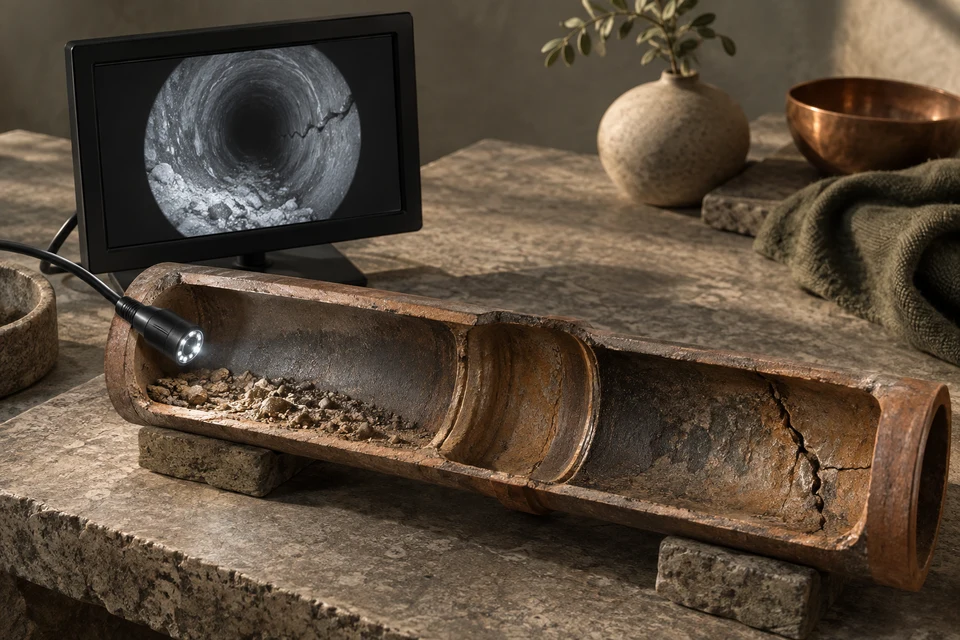
- The condition of the pipe. Only a camera shows cracks, roots, offsets, sags or collapse.
- The private-side material, unless you enter it from a scope report.
- A price. For planning ranges, use the Calgary Replacement Cost Estimator.
- A probability. The bands rank concern; they are not the chance of failure in any given year.
- Your legal position. Disclosure, conditions, holdbacks and contract wording are questions for your lawyer and your REALTOR®.
08 /How to use the result during a Calgary purchase
- Run it the day the offer is accepted
Your condition period is short. Enter what you know and let the band set how hard you push for a scope slot.
- Book the scope early
Aim for the first half of the condition period so there is time to get a quote if the camera finds something. Sewer scope before buying in Calgary covers timing and access.
- Re-run it with the scope result
Change the scope input to clean or defects found and read the new band and checklist, then use what to budget when buying an older Calgary home to set a reserve.
- Price anything the camera found
A written replacement or repair quote turns a worry into a number you can negotiate with. Reading a sewer scope report as a buyer translates common findings into likely remedies.
- Decide with your advisers
For High and Very high results, talk to your REALTOR® and lawyer about the options in negotiating sewer repairs when buying.
Buying in a clay tile community? Calgary's clay tile and cast iron communities shows what the City's data says about the neighbourhood before you even book a showing. When you need a scope or a quote, send a request.
FAQQuestions people ask
Is the sewer risk score a home inspection?
No. It is a points-based checklist tool. A licensed home inspection in Alberta is a separate service, and a standard home inspection does not usually run a camera through the sewer lateral; a sewer scope is typically booked separately.
Why does a clean scope not bring an old clay line down to Low?
Because age and material still matter. A clean scope removes two points, but a pre-1980 clay tile line still carries five points before trees, basement or disclosure are counted.
Does the tool store my address?
No. The lookup queries the City's open data from your browser and nothing is stored by the tool.
What if the lookup says PVC but the house is from 1965?
The City side may have been replaced while your private side is original. Enter the build year, and treat the private-side material as unknown until a scope shows it.
Can I use the result to demand a price reduction?
The result is not evidence of a defect. Scope footage and a written quote are. Use the tool to decide what to investigate, then discuss any negotiation with your REALTOR® and lawyer.
NETWORKGo deeper across the HAUSE Sewer network
How to compare sewer quotes line by line
How to compare sewer quotes: a line-by-line worksheet to normalise scope, spot missing items, convert to per-metre cost and choose between three contractor quotes.
PipeCleaning.caWhat pipe do I have? Identify your drain pipe material
What pipe do I have? Identify a drain pipe from its look, joints, markings and house age, with a confidence rating, safe cleaning methods and camera advice.
SewerRoots.caRoots found in the sewer line during a home inspection: what to do next
Roots found in the sewer line at a home inspection or sewer scope? How to read the finding, get repair quotes before conditions expire, and negotiate.