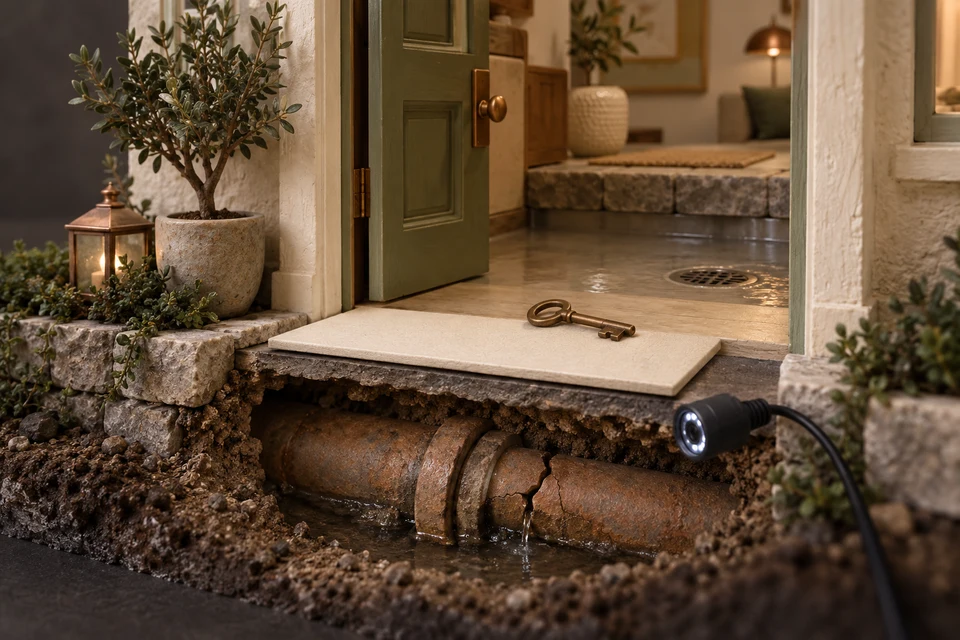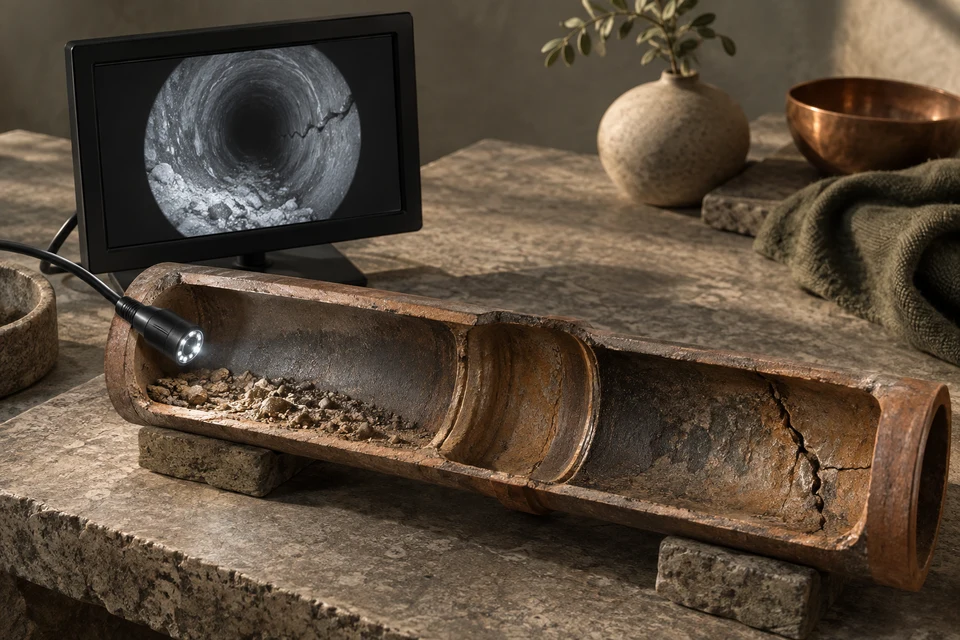
Read a sewer scope report as a buyer by asking three questions of every finding: what remedy it usually needs, roughly what that costs in Calgary, and whether it sits on the private side or past the property line. Light roots are usually maintenance; cracks and offsets point to spot repair or lining; sags, breaks and collapse usually mean excavation or bursting at $10,000 or more.
- Check the basics first: date, address, whether the camera reached the City connection, and whether every finding has a distance.
- A defect's distance from the access point, compared with the distance to the front property line, tells you whose pipe it is likely on.
- Roots at a few joints are usually a maintenance item; cracks along the run, sags and collapse are deal-shaping.
- Lining fixes cracks, roots and leaking joints in round pipe, but not sags or collapses.
- A vague report is worth a second opinion from the same footage before you decide anything.
01 /What should I check first in a sewer scope report?
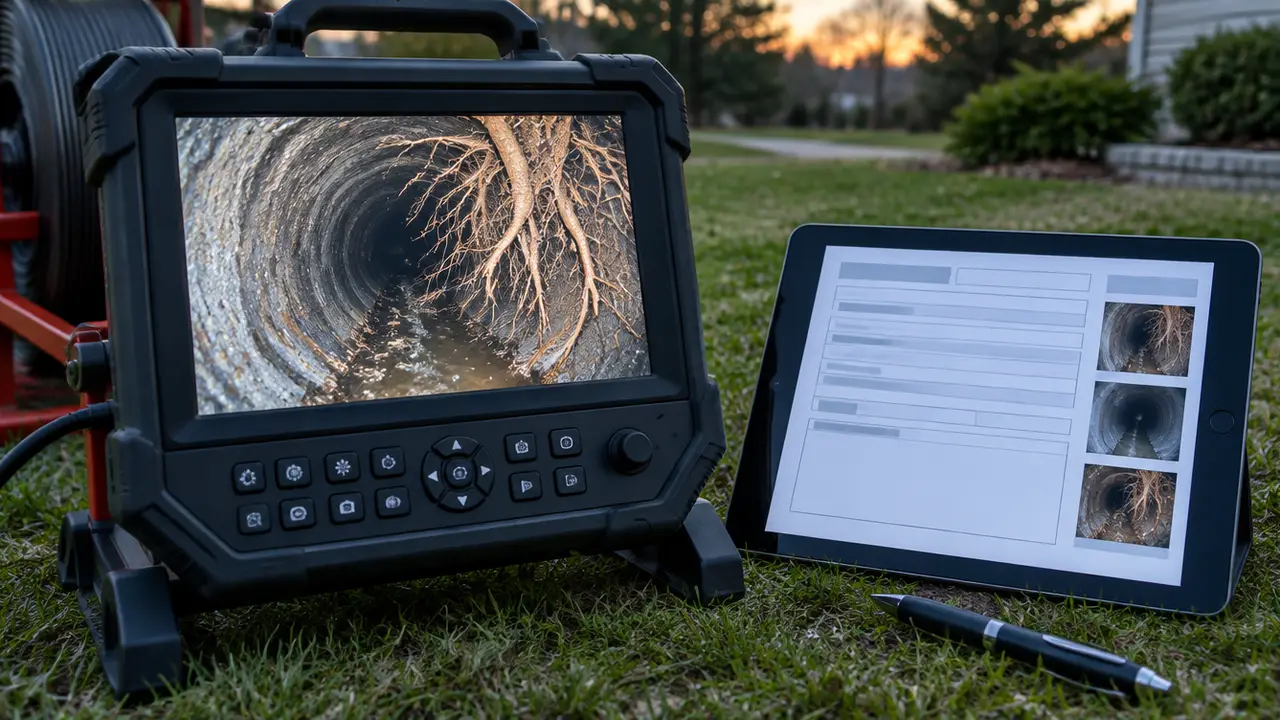
Before reading any defect, check whether the report is complete enough to act on. A buyer only has days, and an incomplete report can send you negotiating over the wrong problem.
| Check | Why it matters | If it is missing |
|---|---|---|
| Date and address on the report and video | Confirms the footage is of this house and recent | Ask for it in writing |
| Where the camera stopped | Tells you how much of the line was actually seen | Ask why it stopped and at what distance |
| Running distance on video and in the notes | Every defect needs a location to be priced | Ask for distances for each observation |
| Material identified | Clay, cast iron and PVC fail differently and are repaired differently | Ask what the camera showed at each section |
| Located defects with depth | Depth and location set the cost of any dig | Ask whether a locate can be added |
A report that says the camera could not pass a point is itself a finding. A blockage the camera cannot get past may be roots, debris, a collapse or a heavy offset; until it is cleared and re-scoped, treat it as unknown and potentially serious.
02 /How do I tell whether a defect is on my side or the City's?
Compare the defect's distance with the distance from the access point to the property line. The City of Calgary's published position, from its service line dataset description, is that the pipe from the sanitary main to the property line is owned and maintained by the City, and the pipe from the property line to the house is owned and maintained by the homeowner.
- Measure the private run. Add the distance from the basement cleanout to the inside of the front wall to the distance from the foundation to the front property line. Alberta sales commonly include a Real Property Report showing the house's position on the lot, which helps with the second measurement.
- Remember the pipe is not straight. Laterals bend and angle, so the camera distance is along the pipe, not across the yard. Treat defects within a couple of metres of the property line as uncertain.
- Look for a material change. Where the private and City sides were renewed at different times, the camera may show a change from one material to another near the boundary.
- Report City-side defects through 311 with the footage and distances. The City makes the determination on its own pipe.
Why this matters for a buyer: a defect on the City side is generally not yours to fix, but it can still cause backups into the house until the City deals with it. Ask the seller to report it before closing, and keep the 311 reference with your records.
03 /What does each common finding mean for the price?
Each finding on a scope report points toward a small set of remedies. The table below gives the usual remedy and a Calgary planning range for a private-side defect, so you can see which findings change the deal and which change your maintenance calendar.
| Finding | Usual remedy | Planning range | Weight in a purchase |
|---|---|---|---|
| Fine roots at one or two joints | Root cutting, camera every 1–2 years | About $450–$1,100 per jetting visit | Low: maintenance |
| Root masses at many joints | Cut roots, then line or replace | $10,000–$26,250 to line 15 m | High |
| Single crack, pipe round | Spot repair or sectional liner | $4,500–$12,000 | Moderate |
| Cracks or fractures along the run | Lining if round; replacement if not | $10,000–$30,500 for 15 m | High |
| Minor offset joint | Monitor, or spot repair if roots use it | $0–$12,000 | Low to moderate |
| Major offset or separated joint | Spot repair, lining or replacement | $4,500–$30,500 | Moderate to high |
| Sag or belly holding water | Excavate and re-lay the section, or replace the run | $4,500–$12,000 per section; $14,250–$30,500 for 15 m open cut | High |
| Heavy scale in cast iron | Descale then line, or replace if the wall is thin | $10,000–$30,500 for 15 m | High |
| Hole, break or collapse | Excavation or bursting; lining cannot pass a collapse | $4,500–$12,000 for one spot; $11,000–$30,500 for 15 m | Very high |
| Grease or debris only | Cleaning; re-scope after | About $200–$450 for clearing | Low |
04 /Which findings should change my offer, and which only my maintenance plan?
Separate findings into three groups before you talk to anyone about price.
- Maintenance items
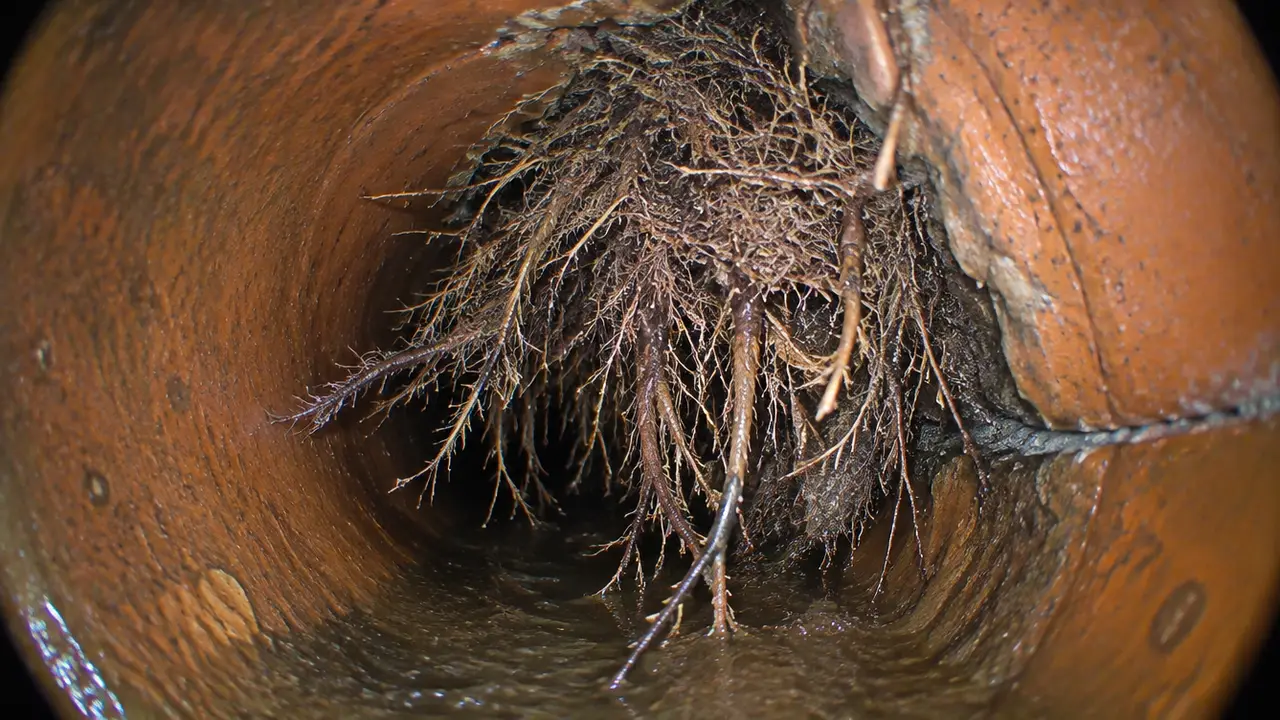
Light roots at a few joints, grease, minor debris, a small offset with no roots. These are normal in older Calgary laterals. Budget for cleaning and a camera cycle; they are rarely grounds to renegotiate on their own.
- Repair items
One cracked joint, one separated joint, a short sag. These need a spot repair or sectional liner soon. They are fair to raise with the seller, with a written quote in hand.
- Deal-shaping items
Defects along most of the run, several sags, heavy cast iron scale, a break, a collapse, or a line the camera could not pass. These usually mean lining or replacement, and the quote should be part of your decision before you go firm.
Context changes the grouping. Roots at three joints in a 1968 clay lateral under a mature boulevard elm will not stay a maintenance item for long. The Home Buyer Sewer Risk Check adds three points for a scope with defects, which pushes most older Calgary houses into the High or Very high band and adds the negotiation checklist.
05 /What if the report is vague?
Some reports say little more than "roots present" or "belly noted". Those words are true but not priceable. Ask the provider, in writing, for the specifics a contractor needs:
- For roots: at which distances, how many joints, and whether they are fine roots or masses that block part of the pipe.
- For a sag: where it starts and ends, and how much of the pipe diameter holds water.
- For cracks: longitudinal or around the pipe, open or hairline, and whether soil is visible.
- For offsets: roughly what fraction of the wall is displaced, and whether it catches the camera.
- For material: what the pipe is at each section, and where it changes.
Some providers code observations using NASSCO's Pipeline Assessment Certification Program (PACP) system, which gives each defect a standard code and grade. PACP codes are not required for a house purchase, but they make a report easier for a second contractor to read. If you get conflicting opinions, ask a second contractor to price the same footage rather than paying for a second scope.
06 /How do I turn a finding into a number I can use?
- Send the footage to a contractor
Ask for a written quote naming the method, the length, the restoration and whether City-side work is included.
- Ask for a second method
Where lining and digging are both possible, ask for both; the gap shows how much the surface is costing you.
- Check it against the estimator
Run the method, length, depth and surface through the Calgary Replacement Cost Estimator.
- Bring it to your advisers
Take the quote to your REALTOR® and lawyer and discuss the options in negotiating sewer repairs when buying.
If you need a written price inside your condition period, request quotes and attach the video. For how material and community era shape what you are likely to see, read what is clay sewer pipe.
FAQQuestions people ask
What sewer scope findings are deal breakers?
There is no universal list, but a collapse, a break, a line the camera cannot pass, several sags, or defects along most of the run usually mean lining or replacement. Those deserve a written quote before you go firm.
Are roots in a sewer line a big deal when buying?
Fine roots at a few joints are common in older Calgary clay lines and are usually a maintenance item. Root masses at many joints usually point to lining or replacement.
How do I know if a defect is on the City side?
Compare its distance on the camera counter with the distance from the access point to the property line. Report likely City-side defects through 311 with the footage.
Can a belly in a sewer line be lined?
Lining follows the host pipe, so a sag stays a sag. A belly is usually fixed by excavating and re-laying the section, or by replacing the run.
Should I get a second scope if the report is unclear?
Usually a second contractor pricing the same footage is enough. A second scope is worth it if the first did not reach the main, had no distances, or the video is poor.
NETWORKGo deeper across the HAUSE Sewer network
Common sewer defects, explained by what they do to the pipe
Common sewer defects explained: roots, cracks, fractures, offset and separated joints, sags, deposits, holes and collapse, with severity and usual next steps.
SewerRoots.caHow fast roots grow back, and how often to cut them
How fast roots grow back in a sewer line after cutting, what sets the interval, how often to schedule root cutting, and when a cycle costs more than a fix.
SewerCleaners.caMain sewer line cleaning: what is actually involved
Main sewer line cleaning explained: how pros access the line, cable vs jetting, camera proof, how long it lasts, and what a complete job should include.