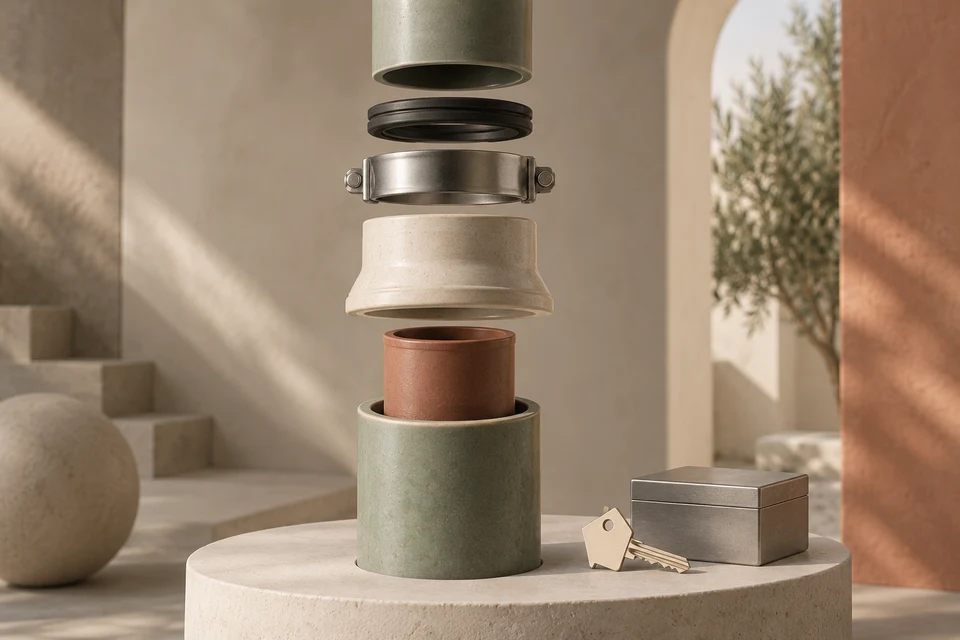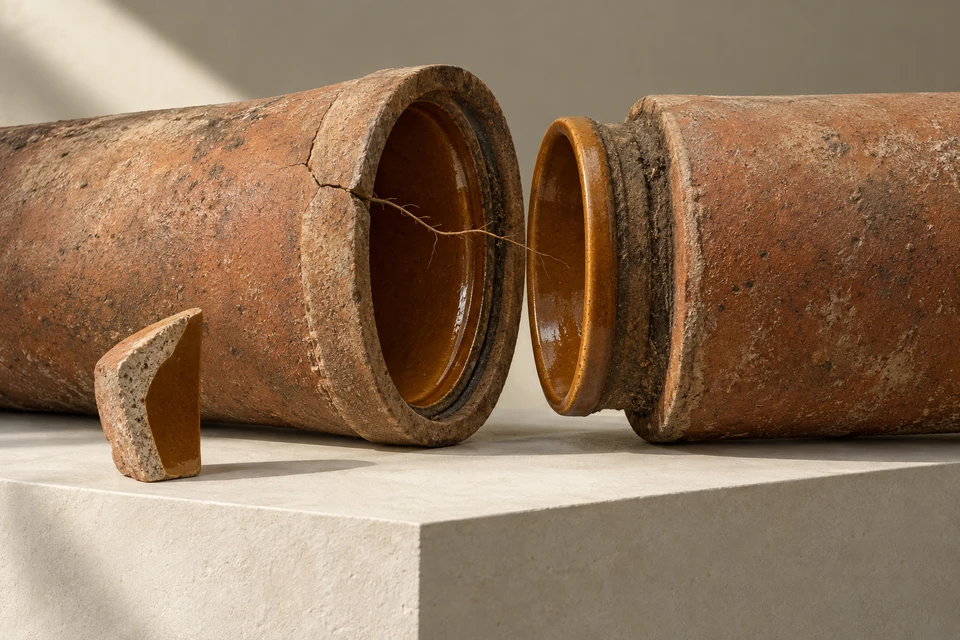
Clay sewer pipe, also called vitrified clay pipe or clay tile, is fired clay pipe laid in short bell-and-spigot sections. The pipe body resists corrosion and can last generations, but its many joints let roots in and shift with the soil. In Calgary's City records, the TIL (tile) code dominates 1960s and 1970s installs and almost disappears after the early 1980s.
- Vitrified clay is durable ceramic pipe; its weak points are the joints, not the pipe wall.
- About one in five of Calgary's City-side service lines carries the TIL code, generally read as clay tile.
- Calgary's clay era on the City side runs mainly from the 1950s to about 1980, with nine in ten TIL records dated in the 1960s or 1970s.
- Clay is rigid and brittle, so point loads, poor bedding and ground movement crack it or offset its joints.
- Clay pipe does not automatically need replacing; its condition, shown on camera, decides that.
01 /What is clay sewer pipe called?
Clay sewer pipe is most accurately called vitrified clay pipe, often shortened to VCP. Plumbers and older records also call it clay tile, sewer tile, terra cotta pipe or simply tile. In the City of Calgary's service line records the matching code is TIL; the City never spells it out, but tile is the obvious and usual reading.
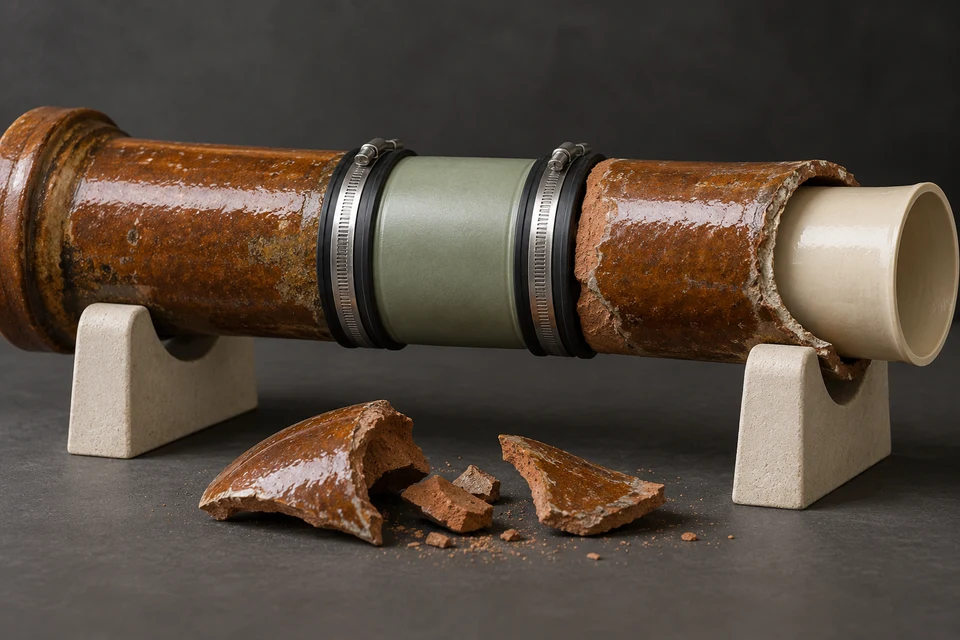
"Vitrified" describes how it is made. Clay and shale are shaped into pipe and fired in a kiln at high temperature until the material partly fuses into a dense, glass-like ceramic. That process is why clay pipe does not rust, rot or dissolve in the acids and gases found in sewage. Many sections were also glazed, which gives them a shiny brown surface.
02 /What does clay sewer pipe look like?
Clay sewer pipe is reddish-brown, orange-tan or dark brown, heavy, and hard like pottery. Residential laterals are commonly 100 mm (4 in) inside diameter, with some 150 mm (6 in) runs. It comes in short straight sections, each with a flared bell at one end that the plain spigot end of the next section slides into.
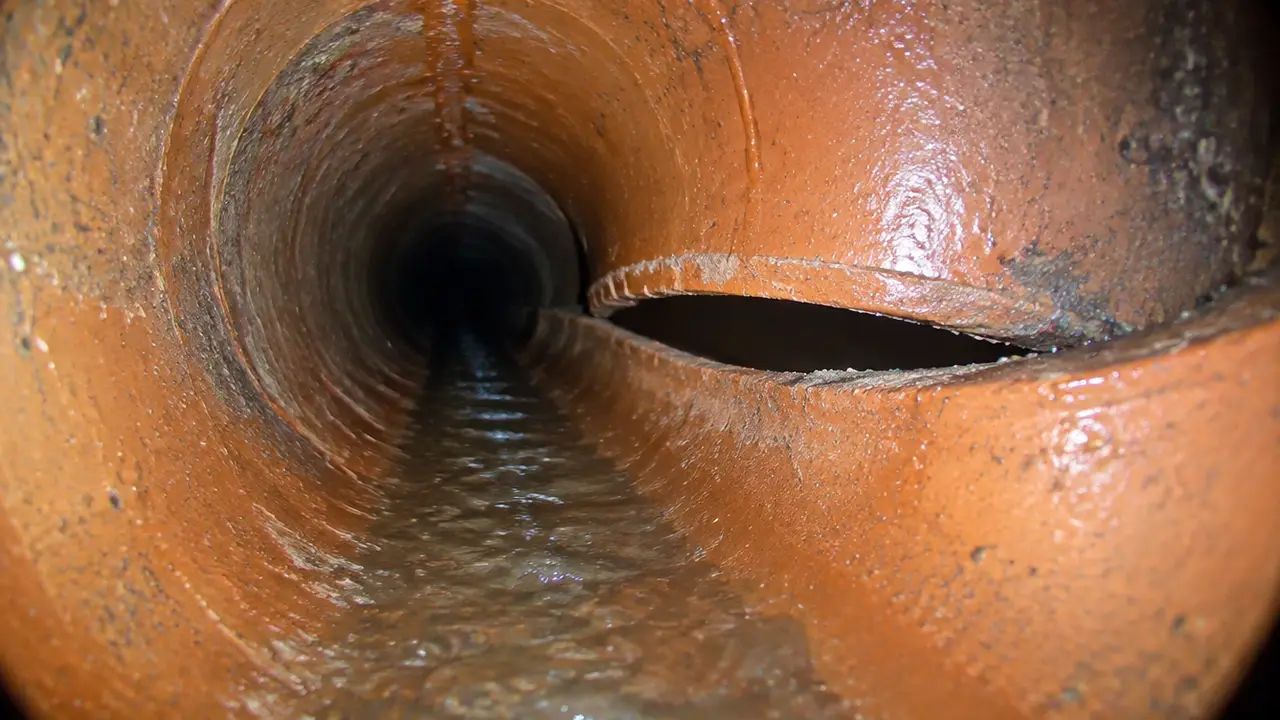
- On camera, clay shows as a tan or brown bore with a visible joint ring at regular intervals, often every 0.6 to 1 m in older laterals.
- At a dig, it looks like heavy terra cotta, sometimes with a glossy glaze and a thick wall compared with plastic pipe.
- Inside the house, you rarely see it. The pipe at the floor cleanout is usually cast iron, ABS or PVC; clay typically starts outside the foundation or under the slab.
Do not confuse clay sewer pipe with clay weeping tile. Some older Calgary houses have short clay tiles laid around the foundation to collect groundwater, often with open joints on purpose. That is foundation drainage, not the sanitary sewer.
03 /When was clay sewer pipe used in Calgary, and when did it stop?
In Calgary's City-side records, clay tile appears in volume in the 1950s, dominates the 1960s and 1970s, and nearly vanishes in the 1980s. The count of TIL records by decade tells the story: 5,775 in the 1950s, 23,376 in the 1960s, 43,777 in the 1970s, 1,158 in the 1980s and a single record in the 1990s. PVC rose from 11,091 records in the 1970s to 29,981 in the 1980s.
So the practical Calgary answer to when clay stopped being used is around 1980 for residential services. Records dated before 1950 are mostly under the City's unexplained OTHER code, so the data cannot say what the oldest inner-city services are made of.
04 /How long do clay sewer pipes last?
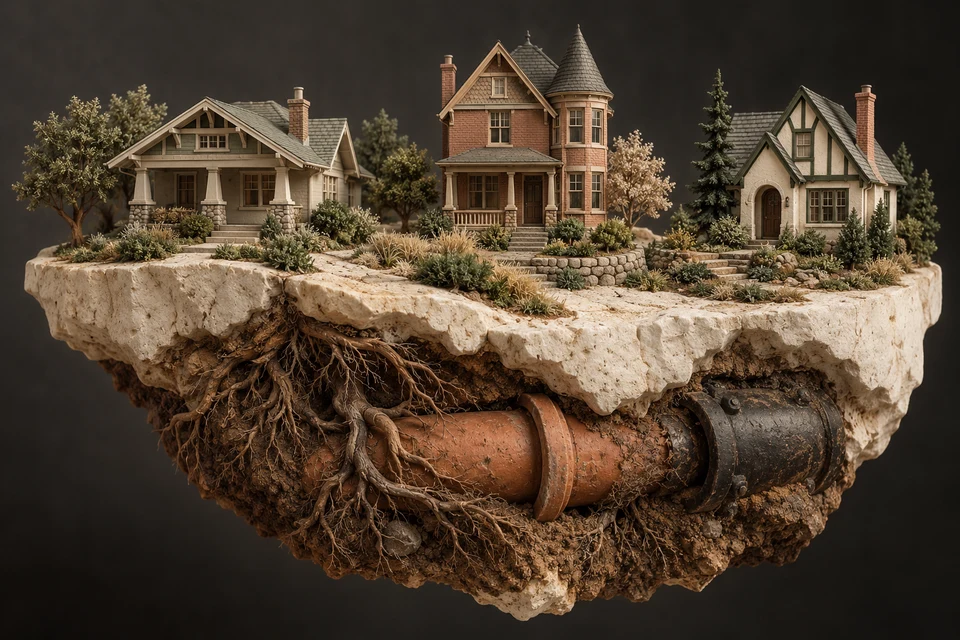
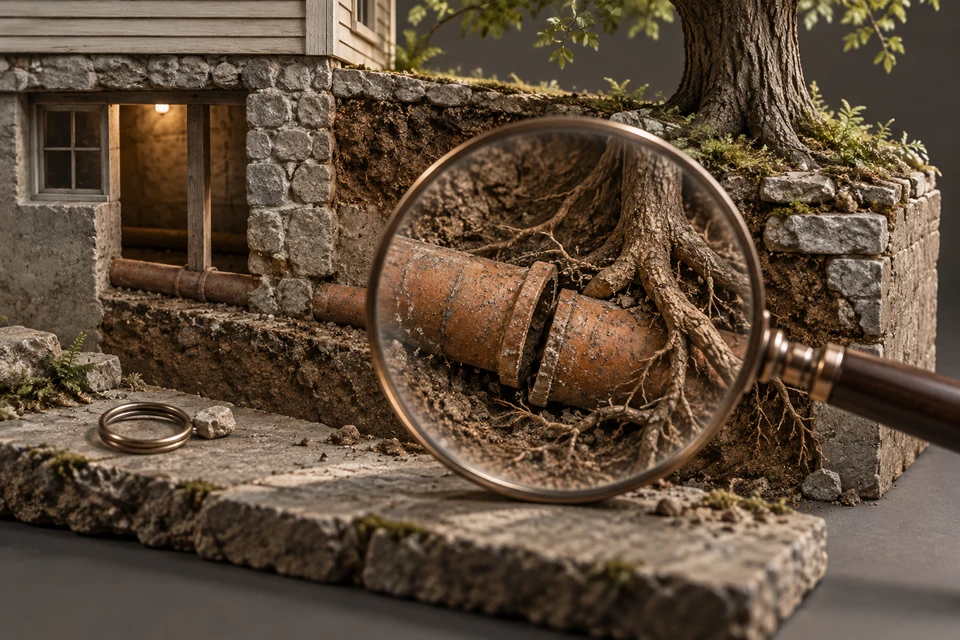
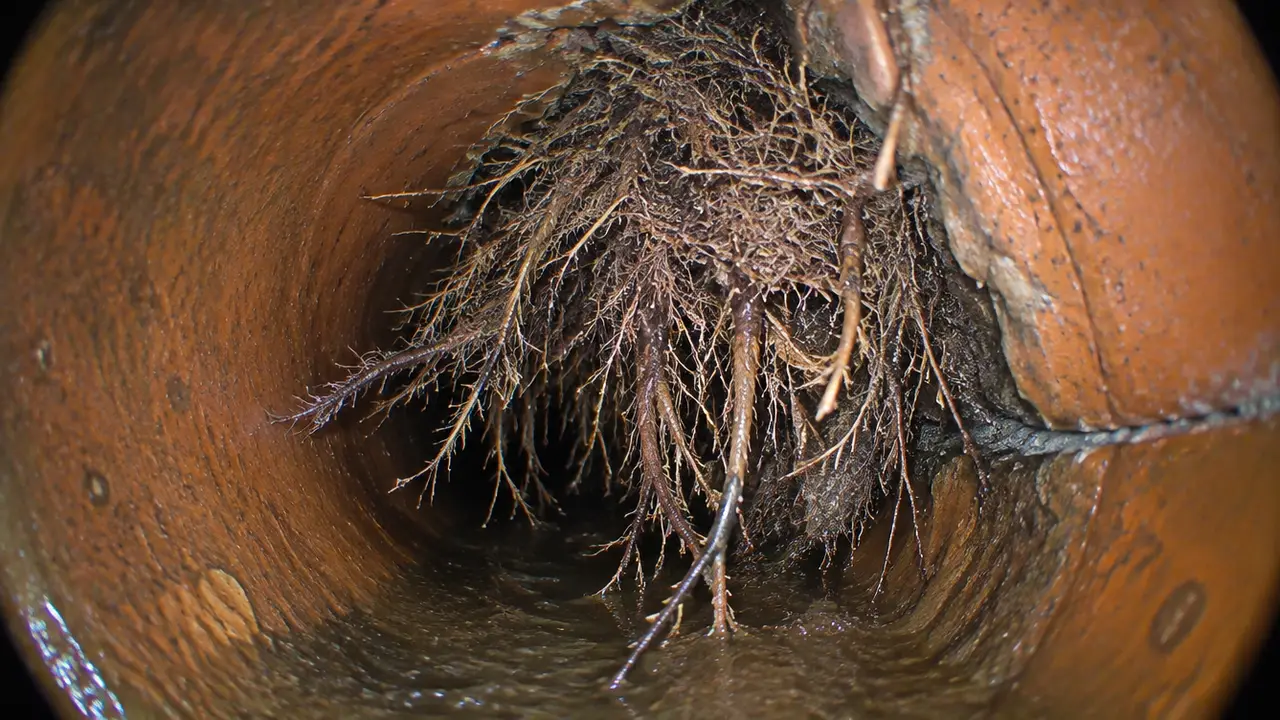
The clay itself can last a century or more; the joints and the ground around them decide the practical life. A clay line that was well bedded, is round and has tight joints can keep working for decades after the house is sold several times. A line with mortar-packed joints under a mature poplar can be full of roots within a few years of the tree reaching it.
| Cause | What happens | What a camera shows |
|---|---|---|
| Roots | Fine roots enter at joints seeking moisture and grow into masses | Root hair or root balls at regular joint intervals |
| Joint movement | Soil settlement, frost and swelling clay shift sections apart | Offset or separated joints, a lip at the bell |
| Point loads | A rock in the bedding, a vehicle or a machine concentrates load | Longitudinal or circumferential cracks, fractures |
| Poor bedding | The line settles unevenly over time | A sag or belly holding water |
| Later digging | Fence posts, landscaping or other utility work strike the line | A break or hole at one location |
Calgary's oldest clay laterals now carry 50 to 70 years of that exposure. That is why a 1960s or 1970s house deserves a camera inspection before you buy it or before you finish the basement, even if the drains run fine today.
05 /Are clay sewer pipes bad?
Clay sewer pipes are not bad pipe; they are old pipe with a known weakness. Vitrified clay resists chemical attack better than most materials and does not corrode the way cast iron does. What makes older clay laterals troublesome is the number of joints, the joint materials used in their era, and the brittleness of a rigid ceramic when the ground moves.
Is clay brittle? Yes. It is strong under the even pressure of soil but cracks under a sharp point load or impact. That is why excavation near a clay line needs care, and why an old clay lateral can be cracked by a new fence post, a tree-removal machine or careless digging for a different project.
Does clay sewer pipe contain asbestos? Vitrified clay is fired clay and shale, not an asbestos product. Asbestos-cement pipe is a different, grey cement-based pipe. Cutting clay does create fine dust that can contain crystalline silica, which is a lung hazard, so cutting belongs to a crew with dust control and respiratory protection. If you are unsure what a pipe is made of, have it identified before anyone cuts it.
06 /Are clay sewer pipes still used?
Vitrified clay pipe is still manufactured and still used in some municipal gravity sewers, because its chemical resistance suits large public mains. Modern clay pipe uses factory-made compression joints and longer sections than the clay laid in Calgary in the 1960s. For residential laterals in Calgary, it has been almost entirely replaced by PVC: the City has just 13 TIL records dated in the 2020s, against 33,959 PVC records.
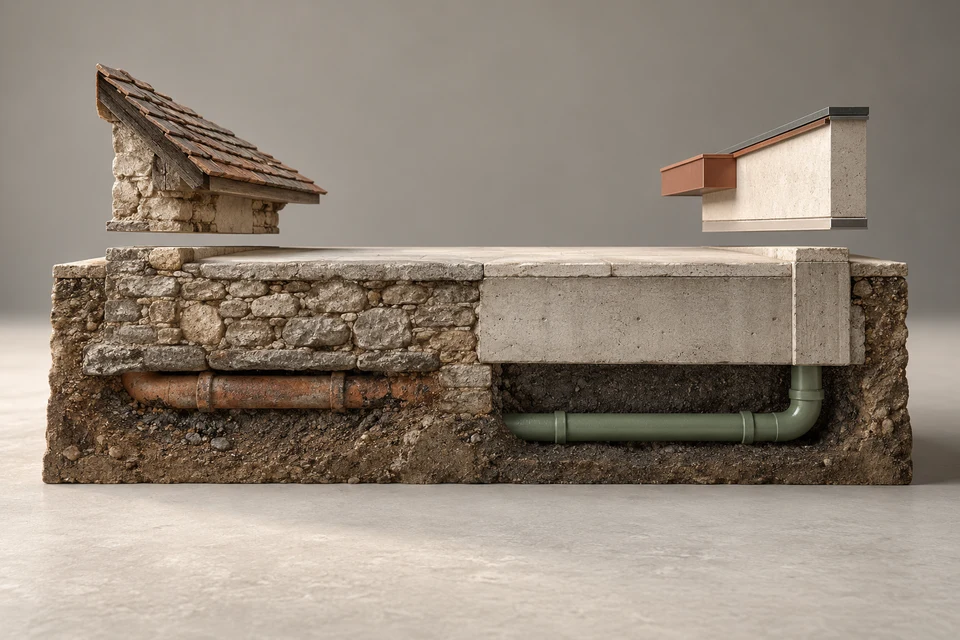
If you are searching for clay sewer pipe for sale, you are most likely looking for a repair fitting rather than new clay. Repairs to an existing clay lateral normally use a PVC section joined to the clay with a shielded flexible coupling sized for the clay's outside diameter. That is contractor work because the joint has to be sealed, supported and kept on grade.
07 /Do clay sewer pipes need to be replaced?
Clay sewer pipes need to be replaced only when their condition says so. Many are maintained for years with periodic root cutting; many are relined; some need a single spot repair; some are sagging, broken or collapsed and have to be dug up or burst out. The camera inspection decides which.
| Condition on camera | Usual response | Planning range |
|---|---|---|
| Light roots at a few joints, pipe round | Root cutting plus a camera every 1–2 years | About $450–$1,100 per jetting visit |
| One cracked or offset joint | Spot repair | $4,500–$12,000 |
| Roots and cracks along the run, pipe round | Lining | $10,000–$26,250 for 15 m |
| Sag, collapse or broken sections | Open-cut or bursting replacement | $14,250–$30,500 for 15 m open cut at typical depth |
Money questions about clay pipe — repair, patch, reline or replace, and what each costs in Calgary — are covered in depth in clay sewer pipe repair and replacement cost. To see whether your community is in the clay tile belt, use Calgary's clay tile and cast iron communities. Buying a clay-era house? Run the Home Buyer Sewer Risk Check, or request a scope.
FAQQuestions people ask
What is old clay sewer pipe called?
Vitrified clay pipe (VCP), commonly called clay tile, sewer tile or terra cotta pipe. Calgary's City records use the code TIL, generally read as clay tile.
How old are clay sewer pipes in Calgary?
On the City side, about nine in ten TIL records are dated in the 1960s or 1970s, so most Calgary clay laterals are now roughly 45 to 65 years old.
What size is old clay sewer pipe?
Residential clay laterals are commonly 100 mm (4 in) inside diameter, with some 150 mm (6 in). The outside diameter is larger than plastic pipe of the same bore, which matters when fitting repair couplings.
How are clay sewer pipes connected?
Sections join bell-and-spigot. Older joints were packed with mortar or other sealing material; later clay used factory-made compression gaskets. Repairs usually join new PVC to clay with shielded flexible couplings.
Is clay sewer pipe good?
The clay itself is durable and corrosion-resistant. Older clay laterals are vulnerable at their many joints, which is where roots and ground movement cause most failures.
Can I tell from the street whether my house has clay pipe?
Not reliably. The City's record for your address describes only the City-owned portion. A camera inspection of your private side is the only way to know.
NETWORKGo deeper across the HAUSE Sewer network
Sewer pipe materials by construction era, and what each looks like on camera
Sewer pipe materials by era in Canadian homes: clay, cast iron, Orangeburg, concrete, ABS and PVC, how each one fails and what it looks like on camera.
PipeCleaning.caCleaning vitrified clay sewer pipe without breaking it
How to clean vitrified clay sewer pipe safely: root cutting at joints, jetting pressure and nozzles, offsets and cracks, and when clay needs repair.
SewerRoots.caRoots in clay and concrete sewer pipe: why older neighbourhoods suffer most
Why roots invade clay and concrete sewer pipe in older Canadian neighbourhoods: joint spacing, mortar and jute seals, mature trees, and how to plan repairs.