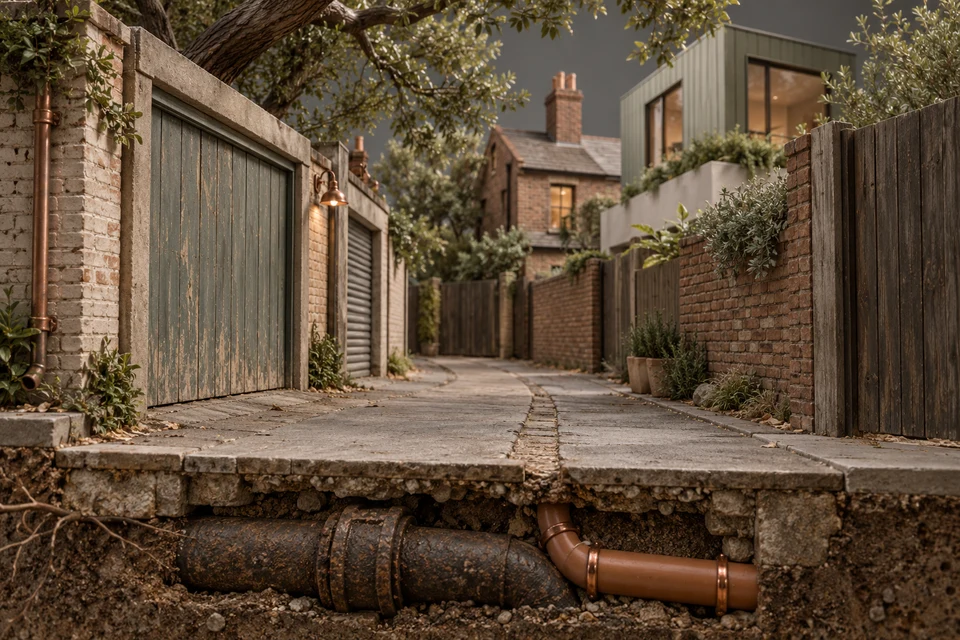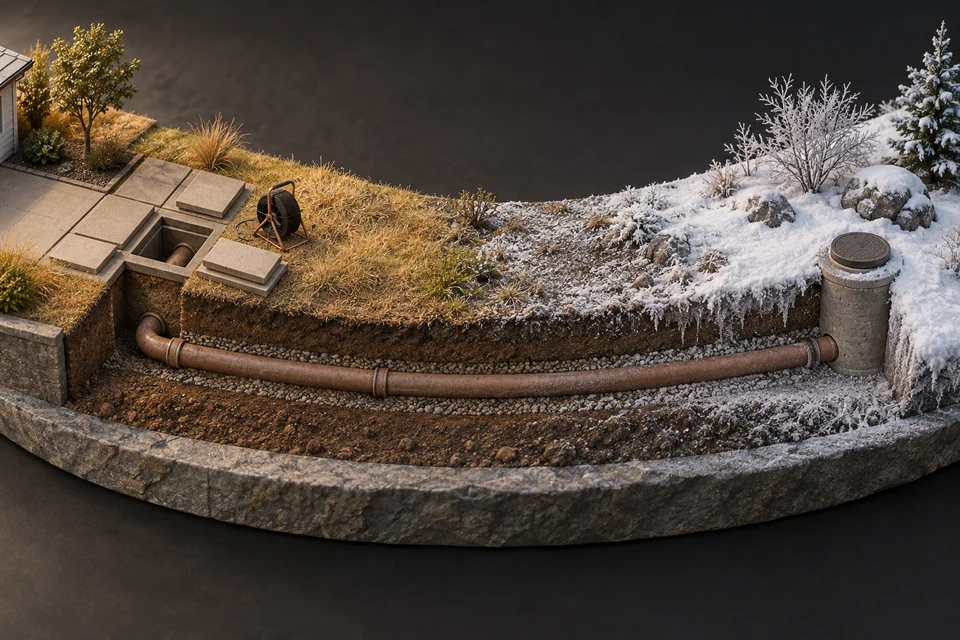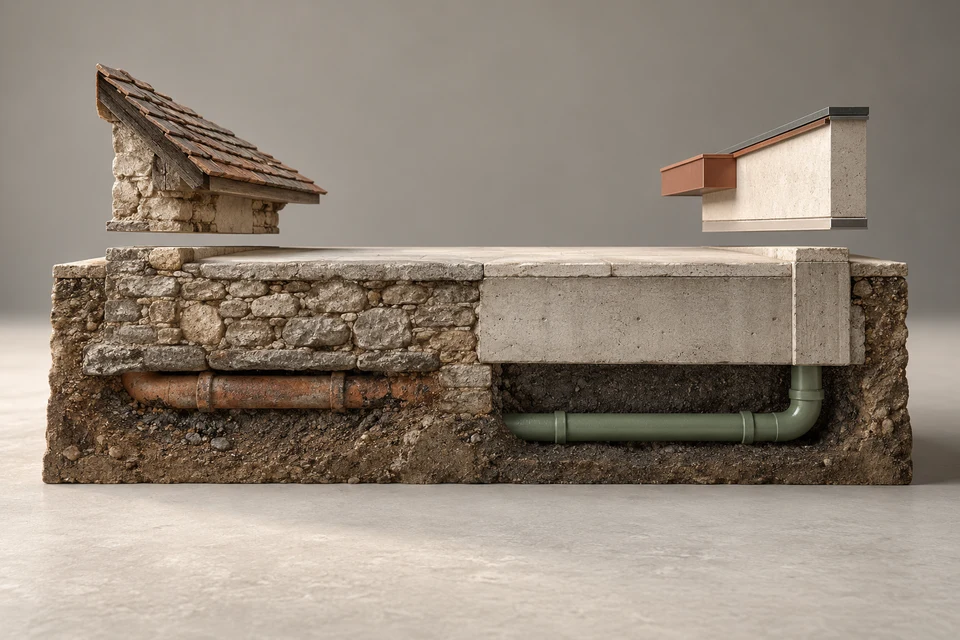
The era a Calgary community was built in predicts what pipe is likely in the ground, and that predicts which repair is on the table and how often it is needed. City data shows 1960s and 1970s communities are about 78% clay tile on the City side, 1950s areas are a mix of clay, cast iron and older codes, and post-1980 areas are mostly PVC. Depth then multiplies the dig.
- About nine in ten of the City's clay tile (TIL) service line records carry a 1960s or 1970s installation date.
- Communities the City classes as 1960s/1970s are 77.5% TIL on the City side; 1950s communities are a less predictable mix.
- Era changes the likely method and the odds of needing work; depth and surface change the price of doing it.
- A deep lateral multiplies open-cut and bursting costs by about 1.25, while lining barely notices depth.
- City records cover the City-owned portion only; your private side needs its own camera inspection.
01 /Does the age of a Calgary community change sewer replacement cost?
Yes, but mostly indirectly. A metre of trench costs roughly the same to dig in Haysboro as in Hamptons. What the era of a community changes is the pipe that is likely down there, how likely it is to need work in your ownership, which repair methods will be proposed, and what sits on top of the line after decades of landscaping, garages and additions. Those factors decide whether you pay for replacement at all and, if you do, how big the bill gets.
The City of Calgary publishes a record for every public sanitary service line: the material code and installed date of the pipe between the City main and the property line. HAUSE joined those 367,397 records to community boundaries and to the City's own community structure classes. The result is a map of which eras put which pipe in the ground.
02 /What pipe did each Calgary era put in the ground?
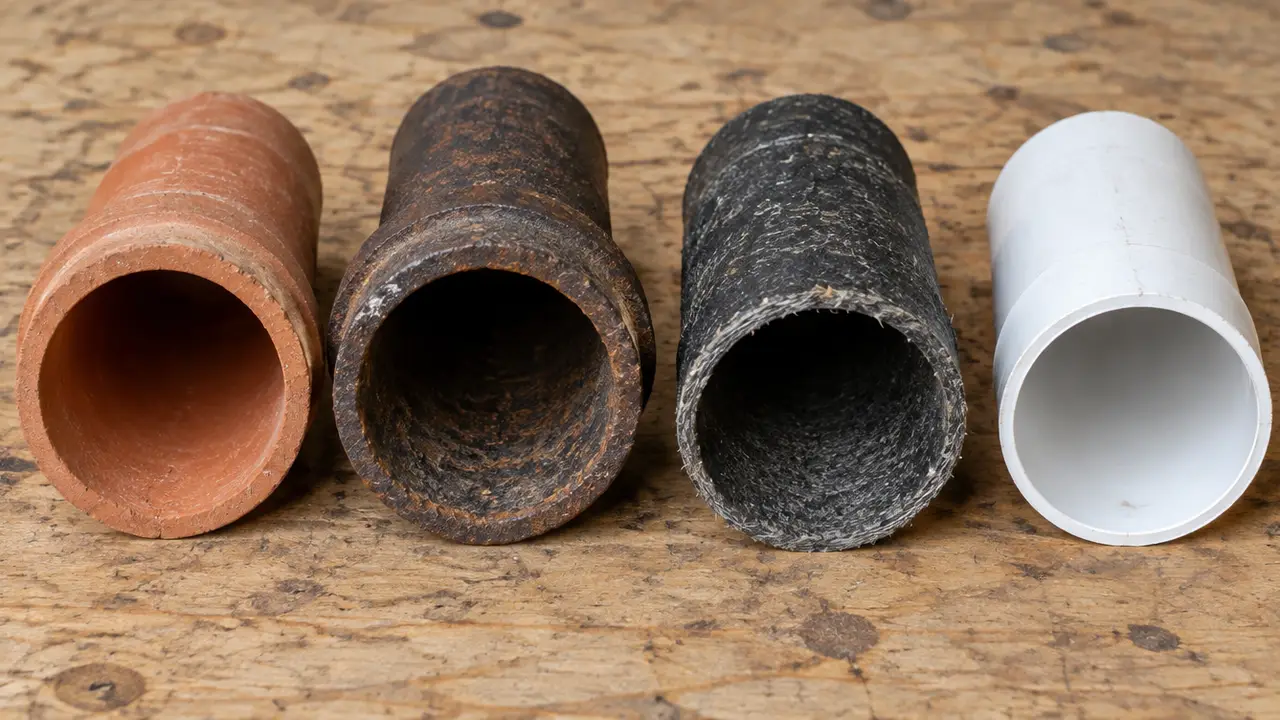
Calgary's service lines fall into clear eras. Records dated before 1950 are mostly coded OTHER, a code the City does not define. The 1950s bring clay tile, cast iron and the unexplained TP code in roughly equal numbers. The 1960s and 1970s are the clay tile decades. PVC takes over in the 1980s and has been almost the only new material since.
| Structure class | Communities | Service lines | % TIL | % cast iron | % PVC | % relined (CIPP) |
|---|---|---|---|---|---|---|
| 1950s | 42 | 46,833 | 23.1 | 18.5 | 22.7 | 3.8 |
| 1960s/1970s | 44 | 71,348 | 77.5 | 0.3 | 17.4 | 1.7 |
| Inner City | 25 | 23,906 | 0.1 | 11.7 | 41.6 | 3.9 |
| 1980s/1990s | 31 | 70,484 | 9.1 | 0.0 | 87.6 | 0.2 |
| 2000s | 27 | 73,482 | 2.1 | 0.0 | 95.7 | 0.0 |
| 2010s | 7 | 26,485 | 0.0 | 0.0 | 98.4 | 0.0 |
| 2020s | 3 | 7,706 | 0.0 | 0.0 | 100.0 | 0.0 |
Two numbers are worth remembering. About nine in ten of the 74,111 TIL records are dated in the 1960s or 1970s, and about 93% of the 12,227 cast iron records are dated in the 1950s through the 1970s. If a Calgary house was built in those three decades, the question is not whether it might have older pipe but which kind.
03 /What does a 1950s Calgary community mean for cost?
A 1950s community means uncertainty, and uncertainty is expensive only if you skip the camera. The City side in these areas is 23.1% TIL, 18.5% cast iron, 22.7% PVC and 3.8% relined, with close to a third under other codes, mostly TP and OTHER, which the City does not define. Neighbouring communities can look completely different: Haysboro is 78.4% TIL, while Rosscarrock is 56.6% cast iron and Rosedale is mostly older codes with 9.3% already relined.
- Clay tile in 1950s areas is often the oldest clay in the city, with mortar or early gasketed joints and 60-plus years of root exposure.
- Cast iron laterals corrode from the inside, building scale that narrows the bore; the usual remedies are descaling and lining, or replacement if the walls are thin.
- Undefined codes tell you nothing about material, so price nothing until a camera identifies the pipe.
- Mature trees and additions are common by now, so restoration and access often decide whether open cut or lining is cheaper.
For budgeting, a 1950s house is the most likely to need a full solution rather than a spot repair, because the whole run has aged together. A lining quote for a typical 15 m lateral plans at $10,000 to $26,250; open cut at typical depth under lawn plans at $14,250 to $30,500.
04 /What does a 1960s or 1970s community mean for cost?
A 1960s or 1970s Calgary community means clay tile, with high confidence. The City classes 44 communities in this era, and 77.5% of their City-side lines carry the TIL code. Maple Ridge is 99.1% TIL, Rundle 97.1%, Marlborough Park 96.9%, Willow Park 96%, and Lake Bonavista 93.3%.
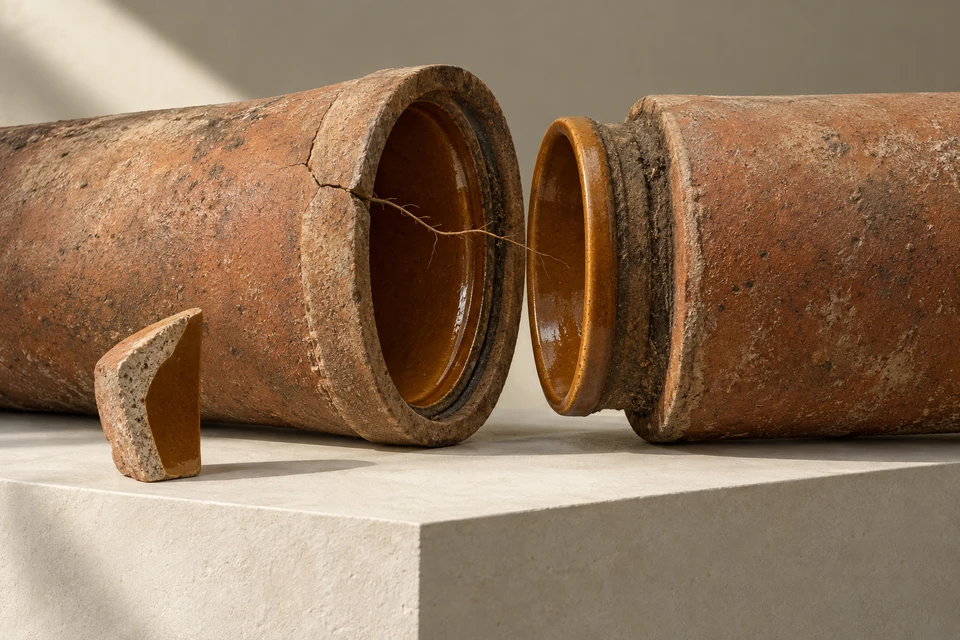
Clay pipe does not rust, and a round, well-bedded clay line can outlast the house. It fails at the joints: every metre or so there is a joint that roots can find and soil movement can offset. That failure pattern has a cost consequence. Many clay laterals in this era are still round enough to line, so relining is often the first full solution proposed, and it avoids tearing up the driveways and mature landscaping these communities now have.
| Method | When it fits | Planning range |
|---|---|---|
| Maintenance (cutting plus a camera cycle) | Roots at a few joints, no structural damage | About $450–$1,100 per jetting visit |
| Spot repair | One cracked or offset joint | $4,500–$12,000 |
| Lining | Pipe still round, defects spread along the run | $10,000–$26,250 |
| Open cut, typical depth, lawn | Sags, collapse, or lining not possible | $14,250–$30,500 |
The clay tile belt also has the city's longest head start on relining. University Heights (19.9% CIPP), Charleswood (7.4%), Huntington Hills (6.8%) and Dover (6.6%) all have meaningful shares of City-side lines already relined, which tells you contractors and the City have been working in these streets for years.
05 /What about the inner city and post-1980 communities?
Inner-city communities show a different pattern: almost no TIL (0.1%), 11.7% cast iron, 41.6% PVC and 3.9% relined, with a large share under other codes from pre-1950 records. The high PVC share largely reflects services renewed over decades of redevelopment. Costs there are shaped by narrow lots, lanes, infill construction next door and older, deeper services. The inner city page covers those specifics.
Communities from the 1980s onward are overwhelmingly PVC on the City side: 87.6% in the 1980s/1990s class and 95% to 100% in newer classes. Replacement in these areas is uncommon. The problems that do appear are usually construction-era defects such as a sag where backfill settled, a joint that was never fully seated or debris left in the line, and they are more often spot repairs than full replacements.
06 /How much does depth add in Calgary?
Depth is the other half of the Calgary cost equation. Laterals here are laid below frost, and depth varies with the lot, the house and the elevation of the main. The Calgary estimator applies × 0.9 for a shallow line and × 1.25 for a deep one to open cut, bursting and spot repair, and leaves lining unchanged.
| Method | Shallow | Typical | Deep |
|---|---|---|---|
| Open cut | $12,825–$27,450 | $14,250–$30,500 | $17,800–$38,125 |
| Bursting | $9,900–$23,850 | $11,000–$26,500 | $13,750–$33,125 |
| Lining | $10,000–$26,250 | $10,000–$26,250 | $10,000–$26,250 |
Depth does not follow community era neatly. A 1970s split-level on a sloping lot can have a deeper lateral than a 1950s bungalow on flat ground. The only reliable depth figure is the one a locator reads off the camera sonde at a few points along the line, so ask for it with the scope.
07 /How do I estimate my own community's likely cost?
- Find your community's pattern
Look up your community's share of TIL, cast iron and PVC in Calgary's clay tile and cast iron communities or on CalgarySewers.ca.
- Check your own City-side record
The address lookup in the Home Buyer Sewer Risk Check reads your street address's City-side material and year.
- Scope the private side
A camera inspection identifies the private-side material, the defects and the depth.
- Run the estimator
Enter the method, length, depth, surface and season in the Calgary Replacement Cost Estimator.
- Get written quotes
Ask for a trenchless price and an open-cut price where both are possible, and request quotes with the footage attached.
The full breakdown of Calgary pricing by method is on sewer line replacement cost in Calgary.
FAQQuestions people ask
Which Calgary communities have the most clay sewer pipe?
Among communities with 300 or more City-side lines, Maple Ridge (99.1% TIL), Rundle (97.1%), Marlborough Park (96.9%), Willow Park (96%) and Parkland (95.2%) have the highest shares of the City's TIL code, generally read as clay tile. City-owned portion only.
Is a 1970s Calgary house likely to need sewer replacement?
It is likely to have clay tile, which fails at joints over time, so it is a strong candidate for a camera inspection. Many 1970s clay lines are maintained or relined rather than dug up.
Are newer Calgary homes safe from sewer replacement costs?
Mostly. Post-1980 communities are overwhelmingly PVC. Their problems are usually installation defects such as sags, which are often fixed with a spot repair rather than full replacement.
Why does depth matter so much?
A deeper trench needs protection, a larger machine, more spoil handling and more compaction for every metre. The estimator multiplies open-cut and bursting costs by 1.25 for deep laterals.
Does the City data tell me what my private pipe is?
No. The records describe only the City's stretch, main to property line. Your own stretch needs a camera to identify.
NETWORKGo deeper across the HAUSE Sewer network
How fast roots grow back, and how often to cut them
How fast roots grow back in a sewer line after cutting, what sets the interval, how often to schedule root cutting, and when a cycle costs more than a fix.
SewerQuotes.comSewer line replacement cost: open-cut vs trenchless, line by line
Sewer line replacement cost in Canada for 2026: open-cut, CIPP lining and pipe bursting planning ranges in CAD, per-metre math, line items and what moves price.
SewerInspector.caSewer scope inspections in Edmonton: what to expect and who to call
Sewer scope and sewer line inspection in Edmonton: what mature and newer neighbourhoods show on camera, cold and clay soils, elms, EPCOR and 311 checks.