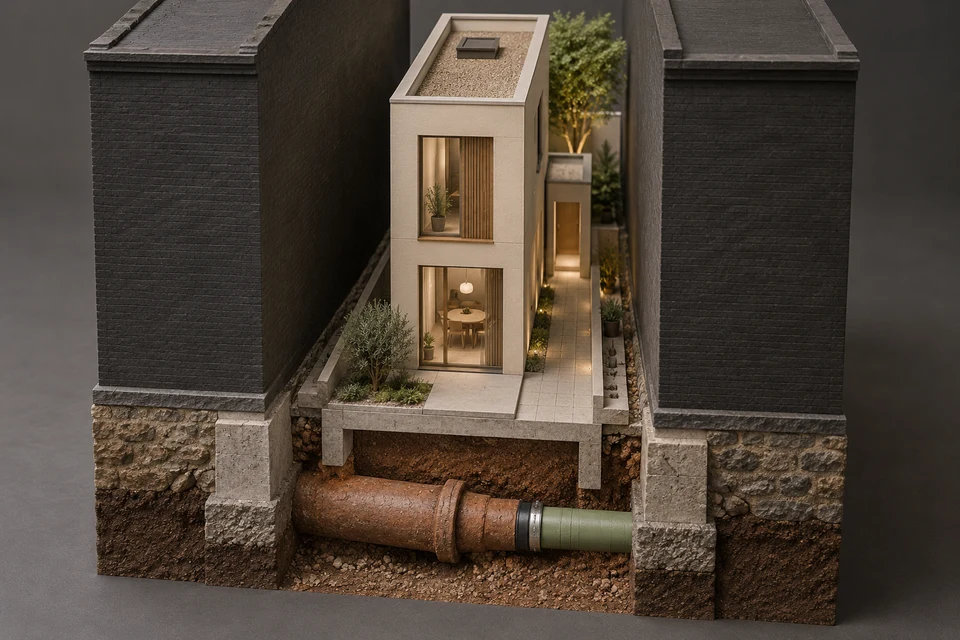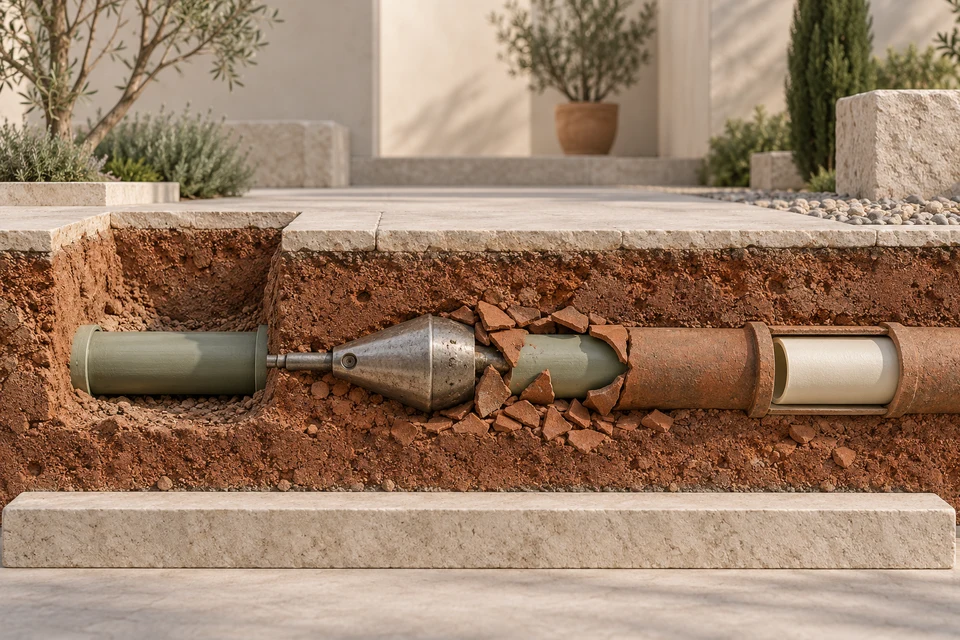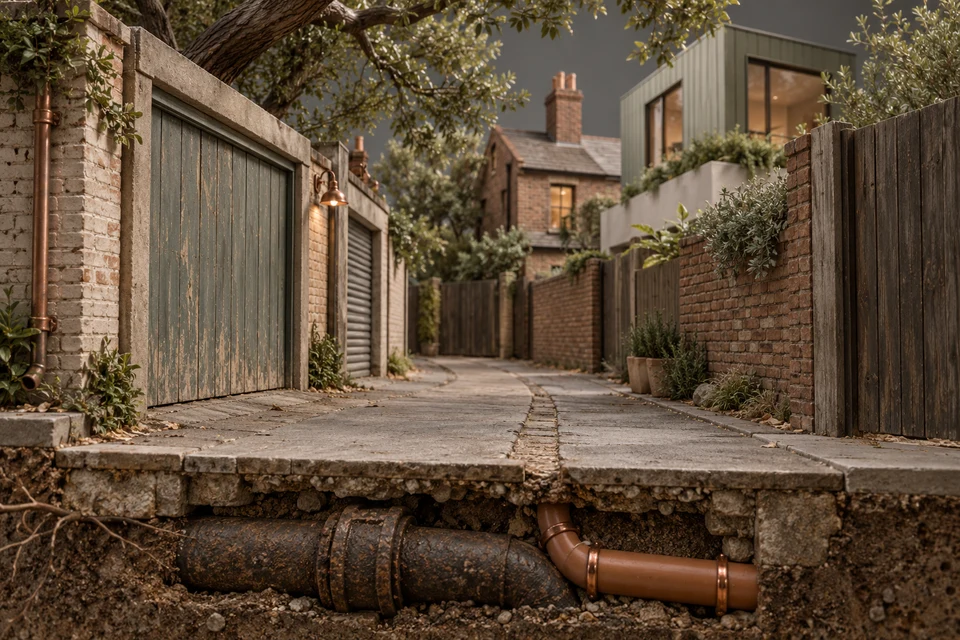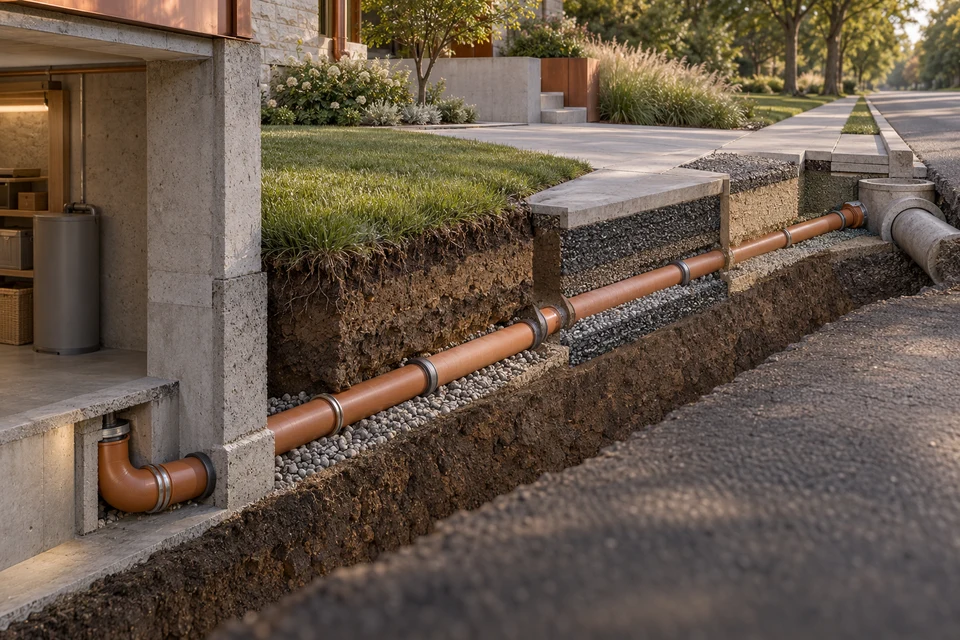
Most Calgary houses have their own sewer service running from the house to the City main, and the main in the street or lane is shared by everyone on it. Some older semi-detached houses, duplexes, lots with garage or laneway suites, and condominium properties do share a private line. A camera inspection shows whether another building connects to yours; your title and any agreements decide who pays.
- The City main is shared by design; the private service from each house to the property line usually is not.
- Shared private lines turn up in some older semi-detached houses, duplexes, suites on the same lot and condominium properties.
- A camera sees a shared line as a branch joining your lateral from the neighbour's direction.
- Who pays to fix a shared line depends on agreements, easements or condominium documents; without them, it is a negotiation and possibly a legal question.
- Most single-family laterals are 100 mm (4 in); public locates do not mark them, so finding yours takes a camera and a sonde.
01 /Do houses share sewer lines in Calgary?
Houses share the City's sanitary main, which runs under the street or lane and collects from every property along it. The service line from each house to that main is usually separate. The City of Calgary describes each service line in two parts: from the sanitary main to the property line, owned and maintained by the City, and from the property line to the house, owned and maintained by the homeowner.
Shared private lines are the exception, but they exist. They are most common where one lot has been divided or where two dwellings were built together:
- Older semi-detached houses and duplexes built with a single service that splits under the yard.
- Houses with a garage suite, laneway home or backyard suite connected into the main house's lateral.
- Townhouse and bare-land condominium properties with private sewer piping serving several units.
- Older lots that were subdivided, where one house's line crosses what is now the neighbour's lot.
02 /How do I know if my sewer line is shared?
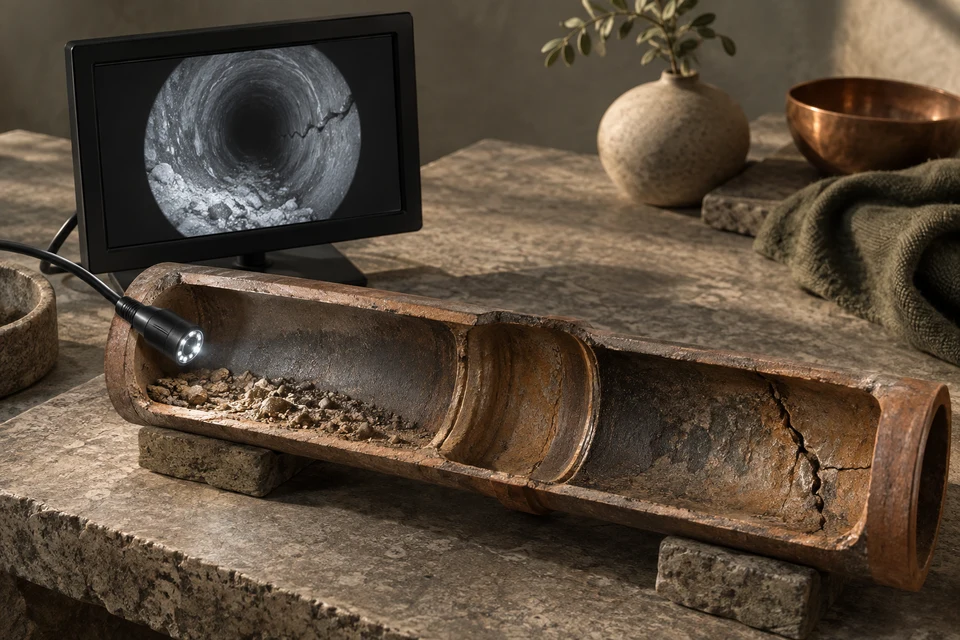
A camera inspection is the most direct evidence. As the camera travels from your cleanout toward the street, a shared line shows as a branch — a wye or tee fitting — joining your lateral from the direction of the neighbouring building. The operator can often push a camera up that branch or run water from the neighbour's side to confirm.
- Scope your lateral
Ask the operator to note every connection along the run and its distance.
- Look up both addresses
The City's public record shows a City-side service for each address it has on file. Two addresses with separate records suggests separate connections at the City end; confirm with 311 if in doubt.
- Check your title
Utility easements, rights-of-way or registered agreements on title can describe shared services. Your lawyer can pull and explain them.
- Read condominium documents
For a condominium, the plan and bylaws say which pipes are common property and which belong to units.
Ask the seller about this when buying a semi, duplex or house with a suite. A shared line is not necessarily a problem, but it changes who you will be negotiating with when it needs work.
03 /Who pays when a shared sewer line fails?
It depends on what is written down. Where a registered agreement, easement or condominium bylaw allocates responsibility, that document governs. Where nothing is written, neighbours usually have to agree between themselves, and a dispute becomes a legal question.
| Situation | Common approach | What to confirm |
|---|---|---|
| Defect on one owner's branch only | That owner pays | The camera distance shows the defect is upstream of the junction |
| Defect on the shared section | Owners share, often equally or by agreement | Any written agreement or easement terms |
| Condominium common piping | Condominium corporation, funded by owners | The plan and bylaws |
| Suite on the same lot | The lot owner | Nothing to split; it is one owner's line |
Two practical points help any shared-line conversation. First, get one camera inspection that both owners can see, with the junction and every defect located. Second, get written quotes that separate the shared section from each branch, so the split can follow the pipe. Lining a shared section and each branch is priced differently from digging, and the Calgary Replacement Cost Estimator gives planning ranges for each.
If you are buying a property with a shared line, ask your lawyer whether an agreement exists and whether it should. It is much easier to agree how to share a cost before anyone has a backup.
04 /Is there a sewer line on my property?
If your house is connected to the City's sanitary sewer, yes: your own lateral runs under your yard from the foundation to the property line, and it is yours to own and maintain under the City's published split; house-to-street sewer line cost in Calgary prices each part of that run. Beyond that, some lots also carry other lines.
- Your own lateral, usually running from where the water service enters the basement toward the street or lane. The City's backup customer guide notes that water and sanitary lines enter the house in the same location, and the cleanout is often near the main water shut-off.
- A neighbour's line, on older subdivided lots or shared services, sometimes protected by an easement.
- Public utilities in a right-of-way, which on some lots run across a front, side or rear yard; these appear on your title.
Your Real Property Report and title are the documents that show registered easements and rights-of-way. Anything registered there limits what you can build over it, which matters when planning a garage, an addition or a deck.
05 /How do I locate my sewer line?
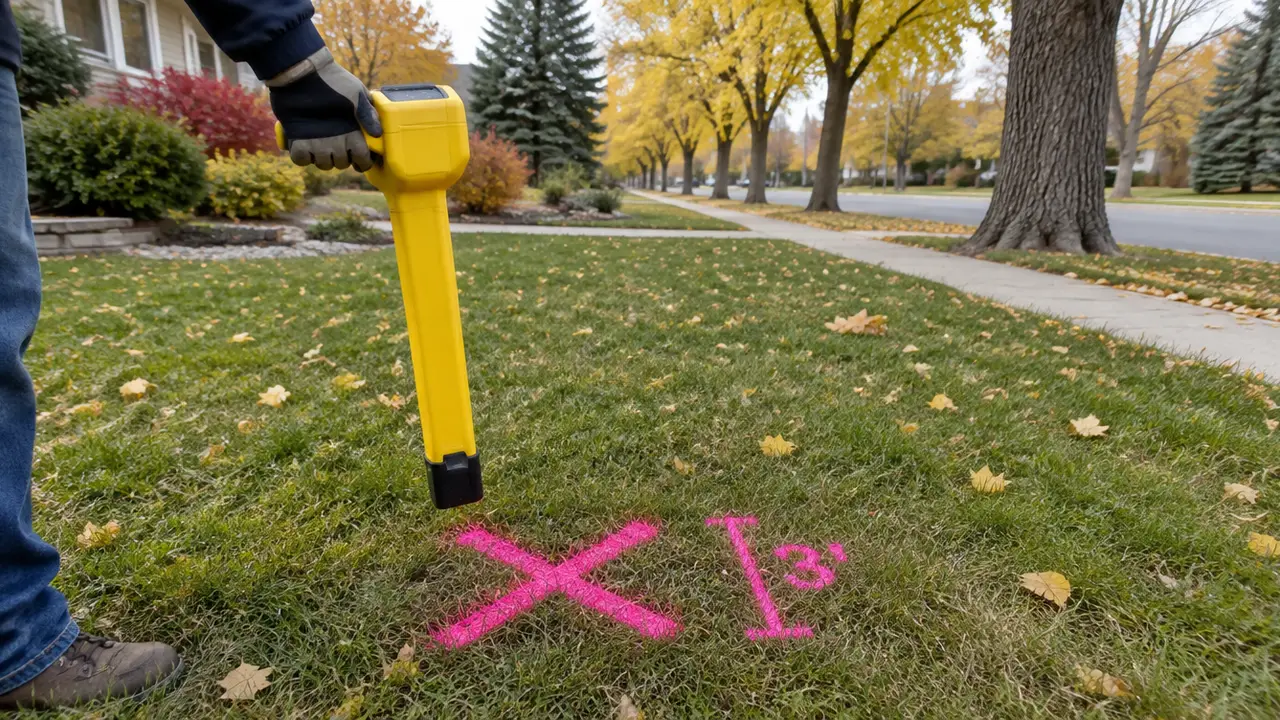
To locate your sewer lateral, a contractor pushes a camera fitted with a small transmitter, called a sonde, into the line from the cleanout. A receiver above ground finds the sonde's signal and estimates its depth, and the route is marked with paint or flags every few metres.
Public locates will not do this for you. Utility Safety Partners, Alberta's one-call service, says lines owned by the customer, water and sewer services included, are not in its registry, so finding yours takes a private locate. You still must request public locates before any digging, at least three full working days ahead.
06 /What size is the main sewer line in a house?
The main sewer line leaving a single-family house, the building sewer or lateral, is most commonly 100 mm (4 in) in diameter. Larger buildings, multi-unit properties and some older services use 150 mm (6 in). Inside the house, the main building drain is typically 75 to 100 mm (3 to 4 in), with smaller branch drains to individual fixtures.
| Pipe | Common size | Notes |
|---|---|---|
| Single-family lateral (building sewer) | 100 mm (4 in) | Sized under the plumbing code for the fixture load |
| Larger or multi-unit service | 150 mm (6 in) or more | Depends on units and fixtures |
| Main building drain inside the house | 75–100 mm (3–4 in) | Collects all branch drains |
| Toilet branch | 75 mm (3 in) | Typical |
| Sink and tub branches | 32–50 mm (1¼–2 in) | Typical |
The City's service line record for an address includes the diameter of the City-side pipe, which the Service Line Lookup on CalgarySewers.ca displays. Adding a suite rarely forces a larger lateral on its own, but if you are adding units or major fixtures, ask your designer or contractor to confirm sizing under the code.
For the cost side of any work on your line, see sewer line replacement cost in Calgary. If a neighbour's infill project is digging near your line, read infill and redevelopment sewer service. To get your line scoped and located, send a request.
FAQQuestions people ask
Do semi-detached houses share a sewer line?
Some older semi-detached houses and duplexes do share a private line that splits under the yard; many have separate services. A camera inspection shows whether another building connects to yours.
Who is responsible for a shared sewer line?
Whatever a registered agreement, easement or condominium bylaw says. Without one, the owners have to agree, and a dispute becomes a legal question.
Is the sewer line under my yard mine?
Your lateral from the house to the property line is, under the City's published split. The City owns and maintains the portion from the property line to the main.
How do I find my sewer line without digging?
Hire a contractor to run a camera with a sonde from your cleanout and mark the route and depth from the surface.
What size is a house sewer line?
Most single-family laterals are 100 mm (4 in). Larger and multi-unit buildings often use 150 mm (6 in).
NETWORKGo deeper across the HAUSE Sewer network
Whose tree, whose pipe: who pays when roots block a sewer line
Who is responsible when a city or neighbour's tree sends roots into your sewer line: the general Canadian pattern, the evidence, and how to raise it.
SewerInspector.caSewer line locating and depth: how the mark on your lawn is made
How sewer line locating and depth readings work: the sonde, the hand-held locator, peak and null readings, marking, accuracy, and calling before you dig.
SewerQuotes.comWho pays for sewer repair: buyers, sellers, landlords, tenants and condo owners
Who pays for sewer repair in Canada: buyer vs seller, landlord vs tenant, condo corporation vs unit owner, and neighbours who share one sewer lateral.